
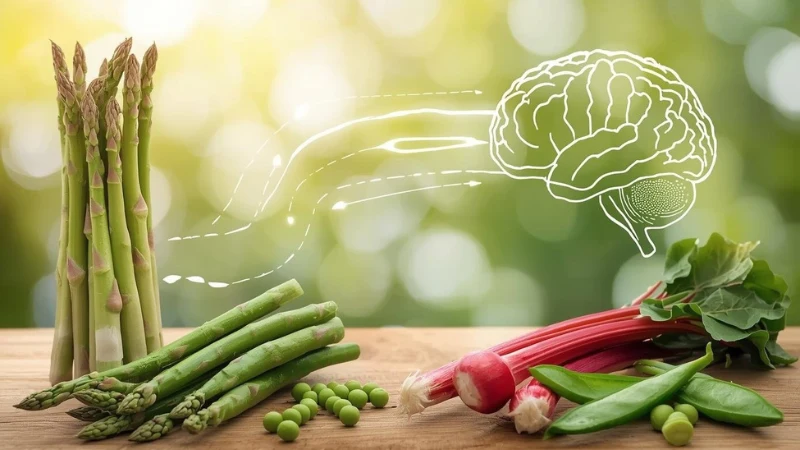
The Gut-Brain Connection: How Early Spring Produce Feeds Your Mood
How Early Spring Produce Feeds Your Mood.
Do you feel weird this time of year? Canadian asparagus, peas, and rhubarb can fix that.
You know that feeling when April rolls around?
The snow has finally melted. The sun stays out past dinner. And yet… You are irritable. Your stomach feels bloated. Your brain is foggy. You snap at your partner over nothing.
If this sounds familiar, here is the good news: you are not broken. You are not imagining it. The solution might be waiting at your local farmers’ market.
Welcome to the gut-brain connection—and why early spring produce from Canadian soil might be exactly what your mood needs right now.
Your Gut Is Talking— to Your Brain, constantly.
Scientists once believed the gut was just a digestive tube. A processing plant. Food goes in. Waste comes out. Simple.
Your gut microbiome is much more complicated than a transport highway.
Your gut—home to trillions of bacteria—does a lot more than break down food. Your microbiome organisms talk to your brain, constantly.
According to researchers at the University of Calgary, the gut and brain communicate through a network of nerves, hormones, and immune signals. That pathway is called the vagus nerve. Think of it as a two-way phone line running straight from your digestive system to your skull [1].
Here is the surprising part: about 90 percent of your body’s serotonin—the chemical that makes you feel calm and happy—is made in your gut. Not your brain.
When your gut bacteria are unhappy, your brain feels it. When your gut bacteria are well-fed and thriving, your mood follows.
Why Spring Messes with Your Gut (and Your Head).
Winter changes us. We eat heavier foods. We move less. We see less sunlight. All of this affects our gut bacteria.
A study from the University of British Columbia found that seasonal changes actually shift the composition of your microbiome. Less dietary fibre in winter means less food for the “good” bacteria. By April, your gut is running on empty [2].
Then spring arrives suddenly. Your body tries to wake up. Your gut tries to adjust. And for a few weeks, you feel off.
Researchers call this a “high perception state.” Your gut and nervous system are both becoming more sensitive at the same time. That’s why small stressors—a late train, a grumpy email—feel enormous.
But here is where spring produce comes to the rescue.
Early Spring Produce: Nature’s Mood Food
The first vegetables to poke through Canadian soil are not just pretty. They are specifically designed to feed the bacteria that calm your brain.
Asparagus.
Asparagus is one of the earliest crops in Ontario, British Columbia, and Quebec. It is also one of the most powerful prebiotics on the planet.
A prebiotic is food for your good gut bacteria. Asparagus is packed with inulin, a type of fibre that your body cannot digest. Instead, it travels to your large intestine, where your good bacteria feast on it. When they eat, they produce compounds that travel up the vagus nerve and tell your brain to reduce stress.
The Ontario asparagus season starts in May. Look for spears that are firm and bright green. The thinner the spear, the more tender.
Peas.
Fresh spring peas are not the mushy ones from a can. Real peas—the kind you pop out of the pod—are loaded with fibre and plant compounds that act like fertilizer for your microbiome.
According to research from the University of Guelph, increasing vegetable intake, including peas, supports the growth of bacteria linked to lower stress and better mood regulation [3].
Peas thrive in the Maritimes and Alberta. If you cannot find fresh peas, frozen peas are frozen within hours of picking. They retain almost all of their gut-health benefits.
Rhubarb.
Rhubarb is a strange one. It looks like pink celery. It is sour. And it is one of the most powerful gut-healing foods you can eat.
Rhubarb contains high levels of plant compounds that specifically feed bacteria associated with lower anxiety. Early spring vegetables like rhubarb help restore the diversity your gut lost over winter.
Rhubarb grows like a weed across Canada. If you have a friend with a rhubarb patch, they will likely give you as much as you want. Just remember: the leaves are toxic. Eat only the stalks.
How to Eat for Your Mood This Spring.
You do not need a complicated meal plan. You just need three small shifts.
- Aim for Two Produce Wins Before 10 a.m.
Most Canadians eat vegetables at dinner. By then, your gut has gone most of the day without fibre. Try adding a handful of peas to your eggs or a few spears of roasted asparagus to your breakfast. Your gut bacteria will thank you. - Eat the Rainbow.
Start with Green and Pink
All vegetables are good. But early spring greens (asparagus, peas, leeks) and pinks (rhubarb) are especially powerful because they match what your gut needs right now. - Walk After Eating
Light walking after meals increases microbial diversity—a key marker of gut health. Gentle movement helps keep your digestive system active and your gut bacteria thriving. Your gut loves movement. And so does your brain.
A Simple Spring Recipe to Get You Started.
Roasted Asparagus & Pea Salad with Rhubarb Dressing
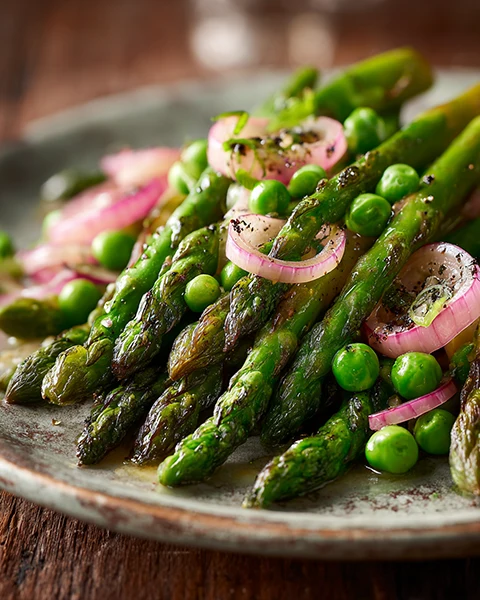
Toss asparagus and peas with olive oil. Roast at 400°F for 12 minutes. Meanwhile, simmer rhubarb with a splash of water until soft. Mash with a fork and stir in vinegar. Drizzle over roasted vegetables. Eat warm or cold.
This dish takes 15 minutes and feeds every single part of the gut-brain connection.
Your spring reset.
Your mood this spring is not random. It is not a character flaw. It’s biology.
I have experienced this in my own kitchen; the first bunch of Ontario asparagus hits the pan, and something shifts. Not just in my meal—in my energy.
Your gut bacteria went through winter with less of the food they need. Now that Canadian soil is waking up, the first vegetables are designed to feed the specific bacteria that talk to your brain.
When you eat asparagus, peas, and rhubarb this season, you are not just enjoying the first taste of spring. You are feeding the trillions of tiny organisms that help you feel calm, clear-headed, and resilient.
Your gut and your brain—the conversation starts with what’s on your plate.
Sources.
- Sharkey K, MacNaughton W, Cavin JB, Wongkrasant P, et al. Intestinal distension orchestrates neuronal activity in the enteric nervous system of adult mice. Journal of Physiology. 2023. Available from: https://nursing.ucalgary.ca/news/ucalgary-researchers-develop-new-imaging-technique-clearer-picture-brain-gut
- Cruz J, Haniak E, Li S, Pepin C, Zhang K. Captivity Status and Climate Impact Gut Microbiome Composition and Function in Primates Through Diet. University of British Columbia Journal of Emerging Microbiologists. 2025;1(1). Available from: https://ojs.library.ubc.ca/index.php/UJEMI/article/view/200773
- Quehl R. Food and Mood: An Investigation Into the Association Between Diet Quality and Depressive Symptoms. Master’s Thesis. University of Guelph; 2015. Available from: https://atrium.lib.uoguelph.ca/items/18fdfc47-219a-4695-b548-01f966c24833/full
About this article: For personalized nutrition advice, speak with your healthcare provider.
Disclaimer:
This article is for informational and educational purposes only and does not constitute medical advice. It should not be taken as a medical diagnosis or treatment.
Always consult with a qualified healthcare professional for personalized medical guidance.
- Share

Magazica Editorial Team
Magazica is a dedicated platform for businesses, subject matter experts, health advocates, and various sectors within the health industry. At Magazica, we are committed to sharing the latest health information and developments with our audience. We serve as a gateway for health-related businesses to showcase their progress and advancements, demonstrating how they contribute to enhancing people's wellness.

The Toll Booth and the Meter: What Canning and Freezing Actually Cost Your Vegetables
What canning and freezing really do to nutrients, why heat sometimes helps, and the acidity rule that keeps...
Farmers’ Market Feasts: Maximizing Local Summer Produce
There is a moment in the Canadian summer—brief, golden, and intensely flavourful—when the farmers' market becomes...

Hydration Hacks: Beyond Plain Water for Summer Sweat Sessions
Canada's summers pack a punch. From the humidity of southern Ontario to the dry heat rolling across the Prairies...
Plant-Based Proteins: Fueling Muscle Recovery Naturally
Whether you're a weekend cyclist, a hockey player recovering from hard practice, or a gym-goer trying to...

Mindful Eating 101: Slowing Down, Chewing Thoroughly and Telling True Hunger From Emotional Cravings
In a world of constant multitasking and rushed meals, many of us finish a plate before our brains have even...

Food and Nutrition in Transition: From Food Security to Plant Proteins
Nutrition underpins health and longevity. Canadians’ dietary habits are...