
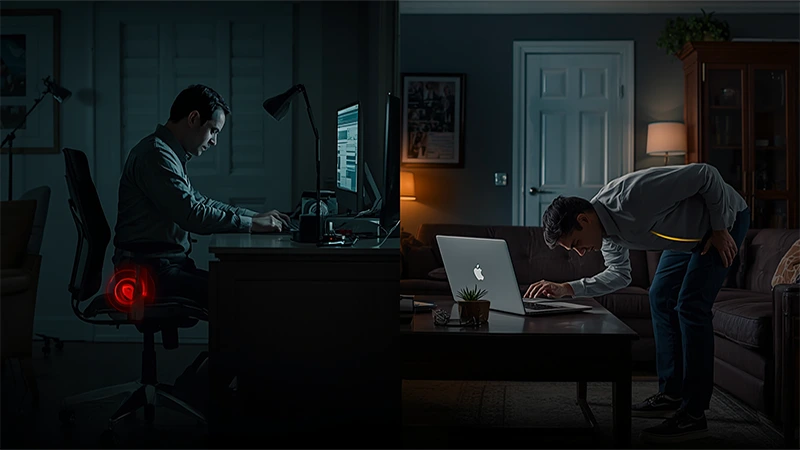
Ergonomics for the Hybrid Worker: Avoiding the Couch-Slouch
You’re on a video call from your kitchen table, laptop propped on a stack of cookbooks, neck craned forward, shoulders rounded like a question mark. Sound familiar? For millions of Canadians navigating the hybrid work era, this is Monday, Wednesday, and Friday — and their bodies are paying the price.
Hybrid work is now a permanent fixture of the Canadian professional landscape. According to Statistics Canada, by late 2023 nearly 12 percent of Canadian workers were in a hybrid arrangement — splitting time between the office and home — a number that has been steadily climbing as employers and employees negotiate the new normal (Statistics Canada, 2023). That flexibility is a genuine win. But it comes with a hidden cost: two workspaces, neither of them quite right.
The Couch-Slouch Problem.
The office, at its best, offers an adjustable chair, a proper monitor, and a desk at the correct height. Home is where the couch, the kitchen counter, and the coffee-table laptop live. Switching between these environments multiple times a week creates an ergonomic inconsistency that accumulates into real injury over time.
According to Benefits Canada, an estimated 11 million Canadians suffer from a musculoskeletal (MSK) condition every year — a number expected to rise to 15 million over the next decade. Remote and hybrid work is a significant driver. A widely cited survey found that 41 percent of remote workers reported lower back pain and 23.5 percent reported neck pain, with half of those workers saying the pain had worsened since they began working from home (Benefits Canada, 2023). The culprit isn’t just the couch — it’s the unpredictability of constantly changing setups combined with long, unbroken periods of sitting.
As one occupational health specialist put it bluntly: “We sit way too long. And then you add the complexity of a work-from-home environment and it’s a recipe for disaster.” (Benefits Canada, 2023)
What the Experts Say: The CCOHS Standard.
Canada’s own Canadian Centre for Occupational Health and Safety (CCOHS) has published comprehensive guidance on office and telework ergonomics — and the principles apply whether you’re in a downtown Toronto tower or your Saskatoon spare bedroom.
According to CCOHS, the foundation of an ergonomic workstation rests on a few non-negotiables:
The core principle is simple: the job should fit the worker, not the other way around.
A Personal Observation — and the Science Behind It.
I’ll admit something here: I have never been able to sit in one spot when I think or problem-solve. I walk around, sit, stand, move from room to room. For years I assumed it was just a quirk — restlessness dressed up as a work style. It turns out there’s hard science behind it.
Stanford University researchers studied 176 adults and found that creative output increased by roughly 60 percent when participants were walking compared to sitting — and the boost held whether they walked outdoors or on a treadmill facing a blank wall. The environment didn’t matter. The movement did. Researchers also found that the creative benefits lingered for several minutes after the walk ended — meaning the brain stays in a more generative state even after you sit back down.
The mechanism appears to involve something called the default mode network (DMN) — a brain system associated with idea generation, introspection, and making unexpected connections. Walking engages it in ways that sitting simply doesn’t. When the body moves rhythmically, the brain relaxes its focused, analytical grip and enters a more free-associative state — exactly the mental space where creative problem-solving thrives.
As the philosopher Henry David Thoreau put it: “The moment my legs begin to move, my thoughts begin to flow.”
So if you pace while on the phone, wander the hallway when stuck on a problem, or find your best ideas come mid-walk — you’re not being unfocused.
You’re doing something neurologically smart. Movement isn’t a distraction from thinking. For many people, it is the thinking.
Making It Work Across Two Spaces.
The real ergonomic challenge for hybrid workers isn’t any one workspace — it’s maintaining consistency across two. Here’s how to bridge the gap practically:
Invest in a few portable essentials. A laptop stand, compact wireless keyboard, and mouse can travel in a tote bag and transform any flat surface from a neck-strain machine into a functional workstation.
Create a dedicated home workspace. Even a small corner with a proper chair and surface makes a significant ergonomic difference. The kitchen table beats the sofa every time.
Embrace intentional movement. Set a reminder every 45–60 minutes to stand, stretch, or walk — even briefly. If you’re a natural pacer or mover, lean into that instinct rather than fighting it. Build walking breaks into your problem-solving process deliberately.
Mirror your office setup at home as closely as possible. Canadian HR Reporter notes that Canadian employers have both a legal and ethical obligation to support safe working environments — even when that environment is an employee’s home (Canadian HR Reporter, 2024). If your employer provides ergonomic equipment at the office, advocate for equivalent support at home.
The Bottom Line.
Hybrid work is here to stay in Canada — and so is the risk of chronic pain if home setups aren’t taken seriously. The good news: small changes make an enormous difference. A laptop stand, a proper chair, a movement reminder, and permission to trust your own instincts about how your brain works best can prevent years of accumulated strain.
Your back will thank you. So will your best ideas.
References.
- Statistics Canada (2023). Research to Insights: Working from Home in Canada. Government of Canada. https://www.benefitsandpensionsmonitor.com/news/industry-news/hybrid-work-arrangements-gain-ground-as-remote-work-declines/383089
- Benefits Canada (2023). How remote, hybrid working arrangements are affecting musculoskeletal issues. Benefits Canada. https://www.benefitscanada.com/archives_/benefits-canada-archive/how-remote-hybrid-working-arrangements-are-affecting-musculoskeletal-issues/
- Canadian Centre for Occupational Health and Safety — CCOHS (n.d.). Office Ergonomics Safety Guide; Telework and Home Office Health and Safety Guide. https://www.ccohs.ca/oshanswers/ergonomics/office
- Canadian HR Reporter (2024). The Changing Landscape of Remote Work in Canada. Canadian HR Reporter. https://www.hrreporter.com/chrr-plus/stats-data/the-changing-landscape-of-remote-work-in-canada/383168
- Share

Magazica Editorial Team
Magazica is a dedicated platform for businesses, subject matter experts, health advocates, and various sectors within the health industry. At Magazica, we are committed to sharing the latest health information and developments with our audience. We serve as a gateway for health-related businesses to showcase their progress and advancements, demonstrating how they contribute to enhancing people's wellness.

Blue Light Glasses: Fact or Fiction for Better Sleep?
As Canadians spend more time than ever staring at screens—with 72% clocking over 8 hours daily on digital devices...
Wearable Tech: Are Fitness Trackers Helping or Hurting Your Body Image?
“By the time you finish reading this sentence, your fitness tracker has likely logged another dozen steps.” In my own experience...

Digital Detox Weekends: Reclaiming Your Attention Span
So, if perusing your weekly screen time report is like binge-watching, well, you are certainly in good company...

Predictive Analytics in Public Health: Preventing Illness Before It Begins
A public health department identifies rising indicators of respiratory distress across a specific neighborhood...

The Predictive Mind: When Generative AI Learns to Anticipate Human Thought
Why Generative AI’s Next Evolution Is Anticipation, Not Automation. Medicine has always been...

Neurocognitive Digital Twin: Human–AI Co-Regulation at the Intersection of GenAI, Psychotherapy, and Neurotherapy
Mental health care is entering a moment of quiet but profound transition. Psychotherapy has always...