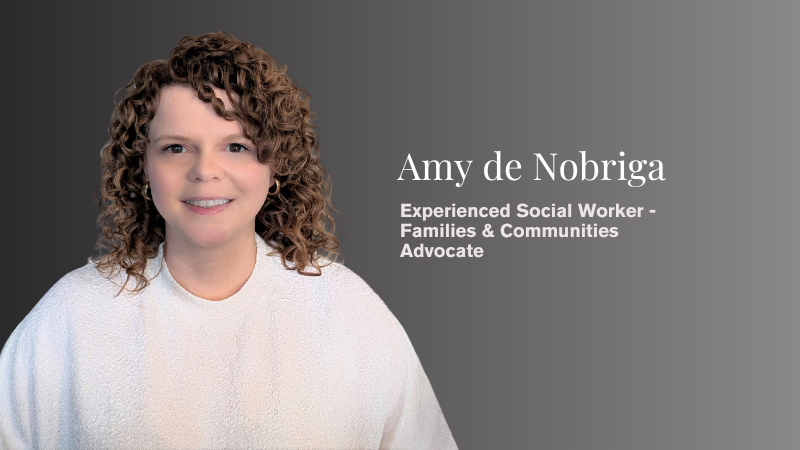
Walking Beside People: Amy de Nobriga on Trauma, Healing, and the Future of Social Work
Some people run toward the fire when others run away. Amy de Nobriga is one of them. For more than twenty years, she has stepped into the hardest moments of people’s lives – crisis, grief, trauma, and uncertainty – and offered something deceptively simple yet profoundly rare: presence. Her work spans NICUs, mental health units, shelters, and family homes, but her mission remains constant – to meet people exactly where they are and walk beside them until they can walk on their own. In this conversation, Amy de Nobriga shares the lessons, stories, and hard‑earned wisdom that shape her practice and remind us that hope is never out of reach.
Magazica: Dear readers and viewers, today we have Amy de Nobriga here with us. She has spent the last two decades helping individuals across age groups – children, young adults, and families – navigate some of life’s toughest challenges. She is an experienced social worker specializing in maternal, child health, mental health, and crisis intervention.
She has worked with leading institutions such as Humber River Hospital, Mount Sinai Hospital, and SickKids, among others. Beyond direct support, Amy de Nobriga is deeply committed to advocacy and systemic change, ensuring families receive the resources they need. Her work is a testament to resilience, compassion, and empowerment. Today, she’s here to share the lessons she has learned along the way. Amy de Nobriga, welcome to Magazica. It’s a pleasure to have you.
Amy de Nobriga: Thank you for that lovely introduction. Thank you so much.
Magazica: So first, let’s start with the note of passion. What drew you to this field? Was there a defining moment or specific experience that shaped your career in maternal and child health?
Amy de Nobriga: Yes. Well, I feel like since I was really little, my parents have always instilled the importance of supporting and helping people along the way. I think I’ve always gravitated toward that work. When I first started out as a baby social worker, I was working in a youth shelter, a family shelter, and in domestic violence settings. I then started working in child welfare, did some family mediation work, and worked at a legal clinic. A lot of my work centred around children and families.
That eventually led to working at Mount Sinai in the NICU, at Humber River in the maternal-child program, and at SickKids in their mental health unit. I think my career just naturally evolved in that direction. I’ve always been interested in working with families because there are so many dynamics and so many people involved – parents, children and extended family. A lot of what shapes us begins at home and in childhood. If we can have an impact from the very beginning, it can make such a difference in people’s lives going forward.
I also had a defining moment years ago when I worked in child welfare, doing supervised access visits. Years later, I was at a graduation, and a young man came up to me. He said, “Amy I was a real jerk to you growing up, and I just wanted to say I’m sorry.” I told him there was no reason to be sorry – he had been struggling through a lot. He shared that he now had a baby and was doing really well.
That was lovely to see.
Magazica: That’s so inspiring. Impact begins at home is a powerful statement. The inspiration you received from your own family clearly guided you toward the supportive role you’ve embraced in your career.
Most people don’t fully grasp the role of social workers in hospitals. You mentioned Mount Sinai Hospital, among others. What does your work involve, and why is it so crucial?
Amy de Nobriga: That’s such a good question. Usually, if I’m going to the hospital in the morning and taking an Uber, the driver will ask if I work at the hospital. The next question is almost always, “Are you a nurse?” I say, “No, I’m a social worker,” and that usually leads to, “Oh, what does a social worker do?”
Social workers in hospitals work across many different units, but our main goal is to complete a psychosocial assessment. Essentially, we look at the story of the person, who they are outside of their medical diagnosis or whatever they’re going through at the hospital.

We provide context to the medical team about who this person is and what they need while they’re in the hospital, as well as after discharge. We look at the supports they already have – family, friends, community – and identify what additional resources they may need through organizations or agencies.
We also help ensure that when they go home, they have what they need to avoid unnecessary re-admissions. There’s a lot of advocacy work, emotional support, and coordination involved, especially in traumatic situations.
Ultimately, people are more than their medical challenges. Our role is to look at them from a holistic point of view.
Magazica: That’s wonderful. Now our readers and viewers will understand the role of a social worker. But still, you have worked with families facing trauma and hardship. What does crisis intervention look like in practice? When a person or a family is going through a traumatic experience, and you are working with them, how does the intervention look, and how do you specifically help people move forward?
Amy de Nobriga: I hear that. I think with a crisis, depending on what is going on, the first sense is providing stability and grounding. For example, unfortunately, I have had to work a lot with the death of children and help people experiencing that.
In that moment, there is nothing you can say when someone is losing a child. They have not even been able to process it after leaving the hospital. When it is happening right there, the main thing is making sure they know somebody is there and really holding space for them – allowing what they need to do, whether that is crying in despair or feeling anger, however grief shows up for them. It is a very common and human experience to feel the way they are feeling.
Providing stability and guidance to move forward is essential, especially from a logistical point of view. Depending on where people are in their stages of grief, the next steps are often logistical. Many people have never planned a funeral before. They do not know the process or how to go about it. So, part of the work is helping navigate the steps they must take so they do not feel alone.
There is also the emotional support – being there with them, helping them process, and making sure they are not alone. There are really great groups for people who have lost children or loved ones, such as Bereaved Families of Ontario or the PAIL Network through Sunnybrook Hospital, where they can connect so they are not alone. In time, they can move forward and do something meaningful to honour their child if they choose to.
That is what crisis work really is – listening, providing space, making people feel heard and understood, and showing that there is a path forward. It should not feel hopeless. We are here to work with them in whatever way they need.
Magazica: I really liked the two words you said at the beginning of this part of the conversation: stability and grounding. You are completely on thin ice whenever you are in crisis. The ground beneath your feet feels very shaky. So, when you talk about stability and grounding, I think these are the two things most needed when a person or a family goes through trauma. This is so true. I never realized it in this way. Thank you for that.
Thank you very much for that. But still, many people and many communities, as I know, still struggle with stigma. There is a certain kind of stigma around mental health. What are some misconceptions you have encountered along the way? And when you find that a person or family has stigma around mental health, how do you shift the conversation into a proactive direction?
Amy de Nobriga: Unfortunately, although we have made strides in mental health – there is the Bell Let’s Talk campaign and many other initiatives – there is still the idea that struggles with mental health are due to a weakness, that something is wrong with you. We have really personalized it.
People struggling with mental health often feel shame. For example, when we think about postpartum anxiety for women, it is important to realize that it is very normal to be anxious. There is nothing wrong with being anxious. What matters is how long we stay in that state and how long it impacts our ability to function. Is it affecting your ability to function as a mom? Is it impacting your ability to sleep or eat?
So we think about how to manage that anxiety. It is okay to feel anxious, or angry, or sad, or overwhelmed. But how do we manage and contain it so it does not overpower every aspect of our lives? That is the main shift.
We also have to look at what is going on in our society – the political climate, economic pressures. If people are feeling depressed, it might be because we live in a capitalistic society where people’s identities are tied to what they do. When you lose your job, you might lose a sense of identity. If we are going through a recession, that affects people deeply.
It is not just the individual. It is what is going on around them. We live in systems. People are impacted by job loss, racism, and many other factors. We do not live in a vacuum. We are social beings affected by what is happening around us.
Magazica: Fascinating the way you put it, because the last part of the conversation about anxiety – I’m personally a college teacher, so I deal with a lot of Gen Zs and the Gen Alphas coming in. They’re anxious. And whenever they’re anxious, for example, just before an exam or before any case study or group assignment, they’re anxious. And whenever they feel anxious, they stop working. So I first say to them, whatever you said fantastically so far – I get the essence of your answer – is that first accept it.
Accept that you are anxious, and there is nothing wrong with it. That is not devaluing you. It is not making you smaller. It is not making you appear negatively in the eyes of others. You are anxious. Anybody can be anxious. Anybody can be angry. Anybody can be frustrated or depressed. So I first say that if you want to overcome the exam, just accept your anxiety and then work with it.
And lastly, what I said about – there’s a big term in philosophy I was reading the other day. It is called status anxiety. We live in a very hyper-consumeristic society. So even if for nothing else, just being in a tough time can create some anxiety. And the way you put it – first accept it, acknowledge it, that it is there, so I have to work with this – fantastic. Thank you for that.
And let’s go to some family challenges. From domestic violence to addiction, families often face overwhelming situations. What advice would you give to someone supporting a loved one in that crisis or in such a crisis?
Amy de Nobriga: I think if you’re witnessing someone going something, there’s always this idea of, “I have to help, but I feel overwhelmed. “What should I do? I don’t know what to do.”
The most powerful thing you can offer someone is simply your presence. Showing up, being there, and truly listening — sometimes that’s enough.”
Sometimes, we might not be able to solve the problem. And I bring it back to when someone has passed away – there’s no way that person can come back. But really just showing up and being there for that person. You don’t have to say anything. You don’t have to come up with beautiful language or flowery language. It’s really just, “I’m sitting with you. I’m here for you. I’m here, and together.”
And if people are feeling overwhelmed, it’s like, “I might not know what to do, but I can support you, and we can figure out together how we can move forward.” If you’re feeling really low and not moving forward, maybe your support parent can connect you with a therapist, a support group, or someone with the skill set you need. If you’re struggling with finances, having someone to sit down with you and help you so you feel less anxious and more in control, and able to make the changes you need. So I think the first thing is sitting with them and letting them know you’re going to be there through this process, and that there is a light.
Magazica: One of the doctors we were talking to in another interview – he’s not a specialist like you in social work; he was a cardiologist – but he said something that reminds me of what you’re saying. He said sometimes people are not looking for solutions. Sometimes people are looking for a person who will listen to them. In that context, is it true? Have you found it true? And in that context, how important is it, as a common person, even in our day-to-day family life or professional life, how important it is to develop the skill of listening?
Amy de Nobriga: Oh, I think it’s so important to listen. The act of listening makes people feel they’re not alone, that there is someone here willing to listen to them. And going back to your thinking, some people don’t want solutions. There is also a theory in therapy and counselling that if you allow people to talk long enough, they solve their own problems.
Magazica: I didn’t know that. That’s fascinating.
Amy de Nobriga: Yes. Sometimes, once people really hear what they’re saying… Actually, funny enough, I was talking with a client – I’m working with at the walking therapist and she asked me, “What should I do?” Then she started talking about it, and I pointed out, “I know you’re asking me, but it seems to me that you solved your problem. Did you hear yourself? You solved your own question. You solved your own problem.” And they’re like, “Oh, ya. That’s that is what I did.” I said that really came from you; it didn’t come from me.
If we allow people to talk and we just listen, and if someone is talking and talking and it feels overwhelming, being the person who can help organize their thoughts and help them see it from a different perspective/or way to connect ideas can really allow them to make the change they’re wanting to make.
Magazica: And just in between, very quickly – I’ll tangent a bit. In your profile on Psychology Today, I have seen your experience in CBT and DBT. So CBT I understand – Cognitive Behavioural Therapy, which focuses on thoughts and how they influence emotions and behaviours.
What is DBT?

Amy de Nobriga: Oh, Dialectical Behavioural Therapy focuses more on emotional regulation, acceptance, as well as skills development, such as radical acceptance.
Magazica: What’s the difference between the two, for our common readers?
Amy de Nobriga: CBT focuses on identifying and changing unhelpful thoughts and behaviours to improve emotions and functioning. DBT build on CBT but emphasizes emotional regulation, distress tolerance, and mindfulness.
Magazica: That’s a big thing.
Amy de Nobriga: Yeah. So, there’s more of that. CBT is more the idea that everything is connected – your thoughts, your feelings, your body. It’s all connected. If you change your thought about something – even if, say, you have a thought like, “You know what, I’m so unhealthy, I’m so overweight,” –
Magazica: Self-talk.
Amy de Nobriga: Yes, all our negative self-talk. But if you change your actions, maybe you start going to the gym, or you start walking, or you start doing something – that’s going to connect and start to change your thoughts and your way of thinking.
Magazica: So, you’re thinking in dialectic.
Amy de Nobriga: Yes. So that’s how I get it. But they’re similar in some ways.
Magazica: So that is for the common readers. You fight for better policies as an advocate of better mental health for all. You fight for better policies and support systems. Can you share a moment where your advocacy led to a meaningful change – even in a very tiny medium, whatever it may be?
Amy de Nobriga: I’ve had the opportunity to work at Osgoode Hall Law School in the community legal clinic. Doing community development at the clinic – helping law students sit in committees in the community, and also social work students in their clinical practice and community practice as well. I’ve had the opportunity to do deputations at City Hall, talking about Toronto Community Housing needs.
But also, going back to the hospital, we’re looking at a policy change for the five-day, five-night program. For people who don’t know, it’s when you go to the hospital – many hospitals in Ontario have this program – and it’s based on research that if someone is at risk for postpartum depression or anxiety, sleep is really helpful in preventing the development of postpartum mood disorders. Sleep is really important.
The idea is that the mom is getting the sleep she needs to care for her baby. Usually, if you have a delivery, you’re there for 24 hours; if you have a C-section, 48 hours. This program gives you extra time to focus on sleep. The baby is with you during the day and usually goes to the NICU or your support system at night so the mom can sleep.
Right now, we’re developing and pushing for a policy change because sometimes when the baby goes to the NICU for medical needs the mom is sent home. The idea is, “She can go home and get the sleep she needs.” But we’re pushing back, because that may be not the case for some people – maybe their home is calming and good for recovery – but not for everyone.
There’s this idea that if the baby is in the NICU, the mom will be fine and no longer needs the program. But even if the baby is in the NICU, the focus should be on the mom. Some people go home to three or four other children. They’re not going to get that supported time to sleep and take care of themselves. Or there might be things going on at home – maybe their partner is kind and caring, but maybe they’re experiencing domestic violence. We don’t know.
The push for this policy is to focus not just on the care of the baby, but on the mental health of the mom. It’s not only the sleep she gets at the hospital – she gets the support of the nursing team, someone to talk to, the support of a psychiatrist if she needs it, the support of a social worker, the support of a lactation consultant for a longer period of time if she’s struggling with breastfeeding or choosing formula feeding. There’s so much support.
My push for that policy is really about separating the care for mom and baby. We have to think that everyone – going back to that psychosocial assessment – has a different experience. It needs to be individualized. We need to think from a bigger perspective than just the idea that the baby goes to the NICU or is taken care of by someone else and that solves the problem. We need to look at the big picture.
Magazica: Yeah. And regarding the babies – that’s… whenever you were explaining this, it sounds so logical. I never thought of it this way. Obviously, you are the expert in that field, but I never thought of it this way as a layman as well – that mom and baby’s care should be separated proactively so that moms and babies get individually better care. Fantastic.
One of your research areas or focus areas of study is the effect of art programs on children’s self-esteem. So, how does – I’m going a bit off on a tangent from our previously talking points. – How does the freedom of creativity help build stronger self-esteem, according to you? What is your take on that?
Amy de Nobriga: Yes. I remember doing that back in university days.
Magazica: Our content team is really, really fascinated by the fact.
Amy de Nobriga: Oh, really. When I did that, actually with my friend Diana, who is now a clinical psychologist, we did that study together. We worked with the Big Brother, Big Sister program. We did visual art, dancing, acting – different kinds of art programs. We were looking at whether there was a difference. Is it better to put your child in music lessons compared to theatre? What is the link to self-esteem?
But when we looked at the study, it really didn’t matter what specific type of art they were doing. It was the idea that arts programs give people a way to express themselves.
To be able to – whether that’s through art, through movement or dance – it gives a way for self-expression. And when you see people dance, it’s like, “Wow, that’s amazing.” So its really kind of intrinsic… if it comes from you, that you created something – “Wow, I was able to master this skill. I was able to do this.” – It builds your self-esteem. Even if you had no training before in dancing or acting, you can say, “Wow, now I have gained this skill, and I’m able to do this.” That’s how we looked at building your self-esteem.
It really is about giving yourself this sense of agency, making you feel good and not judged, and being able to express yourself physically or creatively – just being able to get that stuff out. And especially, again, I know we have to focus on ourselves and intrinsically feel happy about ourselves, but it is so lovely when we get positive feedback from people around us. “Wow, look at this art piece you did. Look at how you’re doing that.” That also really builds the confidence of children – and people of all ages.
Magazica: Yeah, agency is a big part of being creative – that “I have control over the process,” or “I can do it.” That’s a big thing. So many people are entering into this field of social work and helping others who are facing tough times, students and professionals both. From your two decades of experience, what’s the most important lesson you’d pass on to those who are just starting in this field?
Amy de Nobriga: I really like to think it’s about being humble, being curious. You don’t have to come from a place where you have all the answers. Sometimes it’s about asking the right questions. And really, as we were talking about before, the idea that if you listen to people long enough, they solve their own problems.”
I think being curious, being supportive, and understanding other people’s perspectives that might differ from yours is essential. You might have an idea of how the specific problem they’re facing might be solved, but that doesn’t mean that’s the way it will be. Working together with the person in front of you to figure out the best solution you can both develop together – that’s the thing.
And honestly, when you work together, there’s less onus on you to be perfect or the best social worker ever. It’s also about detaching and knowing that people have their own agency. That’s healthy, especially for burnout and your own mental wellness. It’s not about you. It takes your ego out of it. It’s about helping that person. And when you go home, you know you did everything you could with the resources you had to support that person.
It’s not your job to “fix” people. You might provide a different perspective or link them to resources they didn’t know about to help them see things in a different way – which is great. And when people say, “Thank you, you were so helpful to me during that time,” that’s wonderful. But again, don’t personalize it. This was about them. They did the work. You just provided, from your learning and experience, a different way that helped them along their journey.
Magazica: Awesome, awesome. Be humble, be curious, ask the right questions, and most importantly, put the ego outside of the equation so you can facilitate them in the right direction. Fantastic – absolutely spot on. I think people who are just entering the field to become future professionals will benefit hugely, because you’ve summed up so many things in a very short way.
Your work is deeply emotionally demanding. Sometimes you have to listen to people who are in trauma. It is very emotionally demanding. How do you protect – how do you nurture – your own mental well-being while supporting others? What’s the mechanism?
Amy de Nobriga: I think it’s really for you to know yourself very, very well – to be self-reflective and to really know what you need to do to take care of yourself and not taking on people’s burdens as your own. It’s not about being far away or detached so you don’t feel anything – we’re providing empathy – but knowing that what this person is facing is not your problem. We’re all human, and we can only provide as much as we can.
Some things touch us – we’re all human – especially if we’ve dealt with really trying situations, especially death or awful, horrific things that have happened to people. For me, it’s reaching out to the relationships I have with people – connecting with friends, talking things out, walking (as I’m a walking therapist), exercising, doing yoga. Moving my body feels good. Eating the right foods that nourish me – and sometimes some sweets as well.
And also going out and doing things I enjoy, like dancing. That helps me stay grounded. But really, from my experience as a social worker, it puts my life into perspective. We’ve all been through traumatic events in our lives – myself included – but in essence, it gets me into a state of gratefulness. Really grateful.
Sometimes the little things – we can let them go more easily, because we can see there are so many other things that could be worse. Not invalidating your experience, but keeping it in perspective. It helps you productively reframe your thoughts and feelings.
Magazica: Your last point touched me – that whenever you listen to people going through trauma and difficulties and trying situations, you feel empathetic to them, but side by side, it also makes you very grateful. That “at least I’m not living that experience. I’m being empathetic. I’m helping the person, trying to guide the person by being humble and putting all the efforts that I have learned.” But that also reframes my reality as well. And this becomes something that makes you more and more grateful. I hope that is also a powerful thing.
Amy de Nobriga: Yeah, for sure. I think it makes you grateful – especially if you’ve worked with someone who has gone through a similar trauma to you, and they’re in the thick of things. And again, it is about that person. Just because you went through something similar, maybe you would have a different experience of it, and it still would be different. But to know that, yeah, people are not alone. But it also gives you a sense of, “I was there before, but now, because of the past experiences I’ve had, I’m in a different place now.”
That person you were before – you were there – but through growth and the things you’ve done to help yourself, with your knowledge and the way you’ve worked on yourself, you come out the other side. So even if you’ve gone through a similar experience, it can give you clarity for yourself.
Magazica: More learning, more clarity. True. If you could leave our listeners, viewers and readers with one powerful insight – something that could inspire them – what would that be?
Amy de Nobriga: I really think that for anything you’re going through, change is always possible. I think no matter what, there is light at the end of the tunnel. You might not like what you’re going through at that time, and it’s not that you deserve it, but there is hope. There is a way that you can get through things.
I would just say that – there is hope. There’s always hope.
Magazica: There’s always hope. There’s always, always hope. And finally, though I said we would leave our audience with a powerful message, we want to end with your dream. What do you see on the horizon? What do you see in the coming times that you are doing?
Amy de Nobriga: Well, as I’ve started my private practice, The Walking Therapist – delivering counselling services as you walk, like with your dog, pushing a little one in the stroller, or through work or school, like at university, walking around the campus with you – it’s really about mobile therapy. Even coming to your home. I still do phone or video chat too, but essentially, it’s about making therapy tailored to the person in front of me.
I really believe that The Walking Therapist literally is meeting people where they’re at – like their house – and that’s my philosophy as a social worker and therapist: walking alongside them. It’s literally and figuratively what I believe in as a practitioner.
I’m excited about that. I’d like to grow into a group practice, and I’m hoping to provide some free workshops for people as well. I’m excited to continue growing into a group practice and hope to offer free workshops. That’s what I’m really excited about.
Magazica: Walk the talk, walk the therapy.
Amy de Nobriga: Yes, exactly.
Magazica: Fantastic. With that, all the best of luck and good wishes for your effort. You are trying to do things passionately, and you have learned a lot in the last two decades. I hope people will really resonate with that. Thank you so very much for giving us your time.
Amy de Nobriga: Thank you so much for having me. It’s great.
Magazica: Thank you very much, and I hope this is not the last talk. We will have another conversation with some very specific and focused issues in the future.
Amy de Nobriga: I’d like to. Thank you so much.
Magazica: Thank you.
- Share

Amy de Nobriga
Amy de Nobriga, MSW, RSW, is a seasoned social worker with more than two decades of frontline experience in maternal and child health, mental health, and crisis intervention. Her career spans leading institutions, including Mount Sinai Hospital, Humber River Hospital, and SickKids, where she has supported families through some of life’s most vulnerable moments. As the founder of The Walking Therapist, Amy brings a fresh, accessible approach to counselling - meeting clients exactly where they are, both literally and emotionally. Her work blends clinical expertise with deep compassion, advocacy, and a commitment to systemic change, making her a trusted voice in trauma‑informed care and community mental health.
Community Gardens: Cultivating Food and Neighbourhood Bonds
On a sunny Saturday morning in many Canadian neighbourhoods, a community garden is one of the liveliest places...

Indigenous Canoe Journeys: Healing Through Water and Tradition
Think of a river upon which no cedar canoe had set foot for more than a hundred years. Not due to any changes in the...
Living Fully, Caring Deeply: Kirsten Woodend on Nursing, Loss, Resilience, and the Power of Human Connection
Some people spend a lifetime mastering a craft. Others spend a lifetime mastering what it means to be human...

Breaking the Stigma: Community Initiatives for Youth Mental Health in Canada
There is a quiet crisis unfolding in communities across Canada — one that doesn't always make the front page but...

Canadian Indigenous Seed Saving: Preserving Culture and Food Security
For thousands of years, Indigenous peoples have been the original seed keepers of this land. Today, communities...

How Canada’s Health System Frames War-Affected Children: Understanding Complex Trauma in Young Newcomers
A child sits quietly in a clinic waiting room in Canada. The child arrived only a few months ago, having fled a...