Nature’s Unlabelled Aisle: What Late-Summer Foraging Asks of You Before You Eat Anything
Late-summer foraging explained: why there is no shortcut test, what apps get wrong, how the knowledge is really learned, and who to call if you’re unsure.
Coming is the time when the trail behind the subdivision will smell like warm dust and will crush goldenrod. The blackberries will go soft. Something will get to the elderberries first.
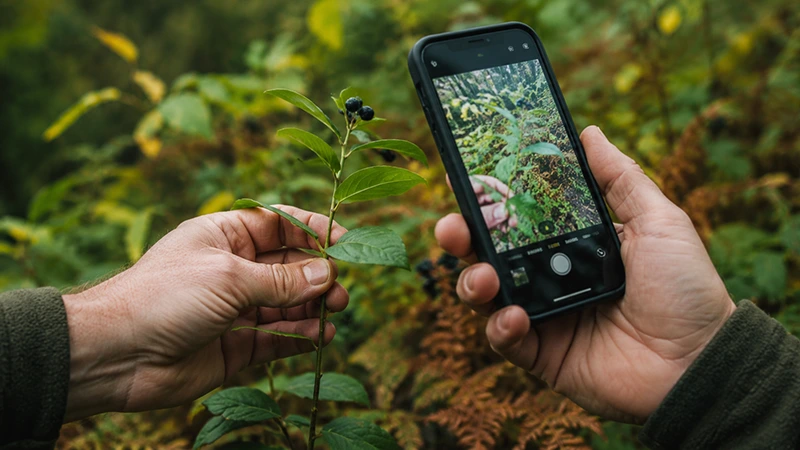
At the foot of a white birch, a cluster of pale mushrooms has come up overnight after Tuesday’s rain. You crouch. You take out your phone because that is what people do now.
The app thinks for a moment and hands you a name with a percentage beside it. The percentage is the interesting part.
Nature’s Unlabelled Aisle.
Picture the late-summer bush as a grocery store where a thorough vandal has peeled off every label. Most of what is on the shelves is inert – bitter, stringy, not worth the walk home. A few things are superb. A very few will put you in hospital.
Nothing on the shelf volunteers which is which, and there is no shortcut. Public Health Ontario, reviewing the evidence on foraged mushrooms, puts it flatly: there are no simple tests for whether a mushroom is poisonous. The folk methods people still swap – the tarnished silver spoon, the idea that anything the squirrels nibble must be fine, the faith that boiling sorts it out – appear in that same document under the heading of myths.
Cooking is not a reset button either. The toxins behind the worst outcomes come through the pan intact.
Takeaway: The wild is not badly labelled – it is unlabelled, and no kitchen trick relabels it.
The Doppelgänger Problem.
So people reach for the phone, which is reasonable, and which is where the second problem starts. A 2023 study tested four popular identification apps on sixteen plant species photographed at several growth stages. They got the genus right 76% of the time and the species right 58%.
The number that matters is a different one. Of eleven potentially toxic species in that study, five were labelled as something edible by at least one app. Those researchers were working in the American Midwest, not Canada, but the botany does not respect the border, and their conclusion was blunt: apps cannot currently be used to decide that a plant is safe to eat.
The other doppelgänger is geographic. Public Health Ontario notes that species growing here can closely resemble genuinely good food from somewhere else – a poisonous Ontario mushroom passing for the paddy straw mushroom of Southeast Asia, or an orange Amanita passing for the Caesar’s mushroom of southern Europe. Bringing a lifetime of accurate knowledge from another country is not a mistake. It is simply knowledge of a different aisle.
Takeaway: Confidence travels with you; the mushrooms do not.
A Language, Not a List.
Long before anyone drafted an evidence brief, people were eating well from this landscape without a poison centre on speed dial. The temptation is to package that as “ancient wisdom” and strip-mine it for tips. That instinct is the problem, not the solution.
Indigenous harvesting knowledge in Canada is not one body of lore. It belongs to hundreds of distinct nations; it is specific to particular territories and seasons, and much of it is taught the way a language is taught – in person, over years, by people accountable for what you do with it. A tip is a single word. This is grammar.
The health literature points the same way. A scoping review of Indigenous food sovereignty initiatives across Canada found harvesting work consistently bound up with knowledge transmission, community leadership and cultural connection rather than technique alone – and documented the other half of the story too: that government restrictions on hunting, fishing and harvesting have themselves limited access to these food systems.
So, what a non-Indigenous reader can borrow is not a plant list. It is the shape of the thing: learn from a person, in a place, over time – and support Indigenous-led food work rather than treating it as a free resource.
Takeaway: Knowledge that took generations to build does not download in an afternoon.
Skin, Stomach, and the Long Fuse.
Two things are worth recognizing this month, and neither requires you to eat anything.
The first is a skin reaction. Sap from giant hogweed and its relatives contains compounds that, once on skin and then hit by sunlight, produce burning, redness, and blistering – usually a day or so later, which is why people rarely connect the rash to the plant. Discolouration can linger for months. Wash sap off promptly, keep the area covered from the sun, and see a clinician for anything blistering or extensive.
The second is a stomach reaction with a long fuse. With the most dangerous mushrooms, symptoms arrive only after a latent period – and in a Toronto case published in 2015, a woman in her fifties who picked mushrooms in a city park became unwell about twelve hours later and went on to develop liver failure. That is one case report, not a rate. But the pattern matters: with wild food, feeling fine for several hours is not reassurance, and stomach symptoms that start late deserve to be taken more seriously, not less.
Takeaway: A delay is not an all-clear; with wild food, late symptoms are the loud ones.
What Careful Actually Looks Like.
Perspective first, because alarm is its own kind of misinformation. Across five years of Ontario Poison Centre data, mushroom calls made up about 0.3% of all calls, and roughly eight in ten involved minimal or no clinical effect. Serious cases are uncommon. They are also, when they happen, extremely serious.
Careful means learning from someone who knows this place, joining a local mycological or naturalist society, and eating only what you can identify without the phone. It means treating “probably” as a no. It means never handing wild food to a child, an older adult or someone pregnant on the strength of a guess.
Conclusion: The aisle stays unlabelled – so bring a person who reads it, not an app that guesses.
Key Takeaways.
This article is for informational and educational purposes only and does not constitute medical advice. It should not be taken as a medical diagnosis or treatment. Always consult with a qualified healthcare professional for personalized medical guidance.
Sources.
Flanagan, K. E., Blankenship, K., & Houk, L. (2021). Botanical briefs: Phytophotodermatitis caused by giant hogweed (Heracleum mantegazzianum). Cutis, 108(5), 251–253. https://doi.org/10.12788/cutis.0389
Garcia, J., Costa, V. M., Carvalho, A., Baptista, P., Guedes de Pinho, P., Bastos, M. L., & Carvalho, F. (2015). Amanita phalloides poisoning: Mechanisms of toxicity and treatment. Food and Chemical Toxicology, 86, 41–55. https://doi.org/10.1016/j.fct.2015.09.008
Long, K., Townesmith, A., Overmiller, A., Applequist, W., Scalzo, A., Buchanan, P., & Bitter, C. C. (2023). Plant identification applications do not reliably identify toxic and edible plants in the American Midwest. Clinical Toxicology, 61(7), 524–528. https://doi.org/10.1080/15563650.2023.2237282
Mobetty, F., Batal, M., Levacher, V., Sebai, I., & Mercille, G. (2025). Exploring Indigenous food sovereignty and food environments characteristics through food interventions in Canada: A scoping review. International Journal of Circumpolar Health, 84(1), 2438428. https://doi.org/10.1080/22423982.2024.2438428
Stein, C. M., Wu, P. E., Scott, J. A., & Weinerman, A. S. (2015). Fulminant hepatic failure following ingestion of wild mushrooms. CMAJ, 187(11), 822–824. https://doi.org/10.1503/cmaj.150080
Additional peer-reviewed source consulted, available if the editor wants the Indigenous-health evidence base widened: Amson, A., Zhang, J., Frehlich, L., Ji, Y., Checholik, C., Doyle-Baker, P., Crowshoe, L., McBrien, K., & Wicklum, S. (2024). Nutritional interventions for Indigenous adults in Canada – opportunities to sustain health and cultural practices: A scoping review. International Journal of Circumpolar Health, 83(1), 2418152. https://doi.org/10.1080/22423982.2024.2418152
Canadian Association for Poison Centres and Clinical Toxicology. (n.d.). Find your poison centre. https://infopoison.ca/
Health Canada. (2023, March 20). Canada launches new toll-free 1-844 POISON-X number for poison centres. https://www.canada.ca/en/health-canada/news/2023/03/canada-launches-new-toll-free-1-844-poison-x-number-for-poison-centres.html
Ontario Agency for Health Protection and Promotion (Public Health Ontario). (2019). Evidence brief: Foraged mushroom consumption in Ontario. Queen’s Printer for Ontario. https://www.publichealthontario.ca/-/media/documents/e/2019/eb-foraged-mushroom-consumption.pdf
- Share

Magazica Editorial Team
Magazica is a dedicated platform for businesses, subject matter experts, health advocates, and various sectors within the health industry. At Magazica, we are committed to sharing the latest health information and developments with our audience. We serve as a gateway for health-related businesses to showcase their progress and advancements, demonstrating how they contribute to enhancing people's wellness.
Elderly Care with Empathy: Dr. Anthony Di Cintio on Bringing Back Medical House Calls
An eighty-eight-year-old man stands in his living room. Tired, near the end of his life. He asks his wife for one....
Saving Lives Before Symptoms Strike: How Dr. David Messika‑Zeitoun Is Transforming Heart Valve Care in Canada
Dr. David Messika-Zeitoun is a global leader in valvular heart disease, combining scientific precision with deeply...
Community Gardens: Cultivating Food and Neighbourhood Bonds
On a sunny Saturday morning in many Canadian neighbourhoods, a community garden is one of the liveliest places...

Indigenous Canoe Journeys: Healing Through Water and Tradition
Think of a river upon which no cedar canoe had set foot for more than a hundred years. Not due to any changes in the...
Living Fully, Caring Deeply: Kirsten Woodend on Nursing, Loss, Resilience, and the Power of Human Connection
Some people spend a lifetime mastering a craft. Others spend a lifetime mastering what it means to be human...

Breaking the Stigma: Community Initiatives for Youth Mental Health in Canada
There is a quiet crisis unfolding in communities across Canada — one that doesn't always make the front page but...