
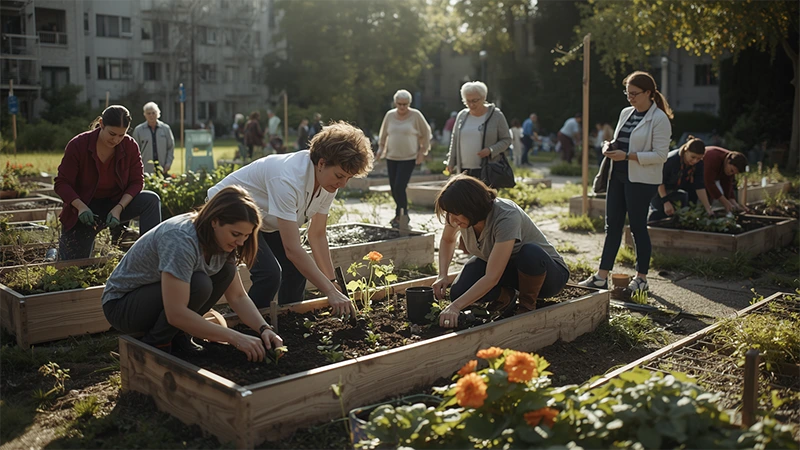
Gardening for the Soul: The Therapeutic Benefits of Soil Microbes
“The connection I feel when I first plunge my hands into the soil — It’s meditative. That warm earth between my fingers has a calming effect. It’s a re-connection that has been forged through centuries. Science is only now beginning to explain what my body has always known.”
There is a reason so many Canadians feel inexplicably better after an afternoon in the garden. Something shifts when hands plunge into soil — a quiet calm settles, the mental chatter slows, and the weight of the day loosens its grip. For generations, this feeling was written off as simply “getting some fresh air.” Science now tells a richer, more fascinating story. The answer may lie not just in the act of gardening, but in the living world thriving beneath your fingernails.
Dirt as Medicine: Meet Mycobacterium vaccae.
At the heart of this story is a bacterium with an unassuming name: Mycobacterium vaccae. This harmless, naturally occurring microbe lives in soil — particularly in rich, organic earth — and researchers have discovered that exposure to it triggers something remarkable in the human brain. When M. vaccae enters the body through skin contact or inhalation (both of which happen naturally during gardening), it activates neurons that produce serotonin — the same neurotransmitter targeted by many commonly prescribed antidepressant medications.
Researchers from Bristol University first uncovered this connection when they noticed that cancer patients treated with the bacterium reported significant improvements in their quality of life and mood. Laboratory studies followed, showing that mice exposed to M. vaccae displayed reduced anxiety, improved cognitive performance, and a more proactive response to stress — without any negative side effects. Further research revealed the bacteria also help reduce systemic inflammation, a condition increasingly linked to depression and mood disorders.
The implications are quietly profound: every time a Canadian gardener turns over a patch of earth, waters a raised bed, or kneels in a vegetable plot, they are potentially dosing themselves with a natural mood enhancer that has evolved alongside humans for millennia.
A Canadian Profession Rooted in Healing.
Canada has its own formal tradition of harnessing the healing power of plants and gardening for mental health — and it is growing. The Canadian Horticultural Therapy Association (CHTA), a national non-profit organization, is the professional body overseeing Horticultural Therapy (HT) and Therapeutic Horticulture (TH) across the country. Its members — Registered Horticultural Therapists — work in hospitals, rehabilitation centres, long-term care facilities, mental health programs, correctional facilities, schools, and community gardens from coast to coast (CHTA, 2024).
According to CHTA, horticultural therapy is a formal, goal-oriented practice that uses plants, gardening activities, and the garden landscape to promote measurable improvements in well-being. It is not simply potting plants to pass the time — it is a clinically structured intervention with defined outcomes, assessment procedures, and professionally trained practitioners. In Canada, therapists operate in settings as diverse as palliative care wards, addiction recovery programs, and youth mental health facilities.
At Homewood Ravensview — a 75-bed mental health facility on Vancouver Island — a Registered Horticultural Therapist works directly with patients as part of an integrated treatment team. In Ottawa and across Ontario, practitioners are embedding horticultural therapy into programs for youth with concurrent mental health and addiction challenges, specifically because gardening offers something that many clinical settings struggle to provide: engagement, purpose, and a living connection to the natural world.
What the Research Confirms.
The science backing horticultural therapy is increasingly robust. As Canada’s National Observer reported in an in-depth feature on the field, a landmark review of 22 case studies found that gardening has a significant positive effect on health outcomes — reducing depression, anxiety, stress, and mood disturbance, while increasing quality of life, sense of community, and cognitive function.
A meta-analysis published in Nature found that horticultural therapy participants experienced reduced anxiety, improved cognitive functioning, and increased happiness after each session (Canada’s National Observer, 2022).
Closer to home, research exchanged through Memorial University of Newfoundland’s Research Exchange Group on Horticultural Therapy — a collaborative forum linking community organizations, academic institutions, healthcare, and correctional settings — continues to explore how these interventions can be tailored to diverse Canadian populations, including Indigenous communities, people living in institutional care, and individuals facing housing insecurity (Memorial University of Newfoundland, NLCAHR).
Research also points to neurobiological mechanisms beyond serotonin. Therapeutic gardening activities have been shown to elevate levels of Brain-Derived Neurotrophic Factor (BDNF) — a protein critical for neural survival and cognitive flexibility — by up to 36 percent after just 20 minutes of engagement. As Dunham House, a Quebec-based dual-diagnosis treatment centre with its own 7,000-square-foot therapeutic garden, has observed firsthand: as clients nurture plant life, they simultaneously learn to nurture themselves (Dunham House, 2024).
Getting Your Hands Dirty: A Practical Invitation.
You don’t need a formal diagnosis or a clinical referral to benefit. The microbes don’t check credentials. Whether you have a sprawling backyard in the Ottawa Valley, a community garden plot in Vancouver, a balcony container garden in Montreal, or a few herb pots on a Winnipeg windowsill — regular, mindful contact with soil and plants offers genuine mental health benefits that are now backed by a growing body of evidence.
A few things worth knowing as you dig in:
Ancient Instinct, Modern Validation.
Indigenous peoples across Canada have always understood the reciprocal relationship between human beings and the living earth. What Western science is now catching up to, is something that was never a mystery to communities whose relationship with the land was never severed: that the soil is not just where food grows. It is where healing begins.
As Canadians — navigating long winters, increasingly urban lives, and growing rates of anxiety and depression — the garden may be one of the most accessible, affordable, and underused tools in our mental health toolkit. The microbes are there, waiting patiently in the dirt, ready to do what they have always done.
All we have to do is dig in.
References.
- Canadian Horticultural Therapy Association — CHTA (2024). About Horticultural Therapy; About Us. https://chta.ca/ and https://chta.ca/about-us/
- Canada’s National Observer (2022). What is horticultural therapy? https://www.nationalobserver.com/2022/08/17/news/horticultural-therapy-what-is-it
- Memorial University of Newfoundland — NL Centre for Applied Health Research (2024). Research Exchange Group on Horticultural Therapy. https://www.mun.ca/nlcahr/research-and-knowledge-exchange/horticultural-therapy/
- Dunham House Dual-Diagnosis Treatment Centre, Quebec (2024). Horticultural Therapy: How Gardening Supports Mental Health and Addiction Recovery. https://www.dunhamhouse.ca/blog/horticultural-therapy-nurturing-healing
- Share

Magazica Editorial Team
Magazica is a dedicated platform for businesses, subject matter experts, health advocates, and various sectors within the health industry. At Magazica, we are committed to sharing the latest health information and developments with our audience. We serve as a gateway for health-related businesses to showcase their progress and advancements, demonstrating how they contribute to enhancing people's wellness.
Heatwave Safety: Recognizing and Preventing Heat Exhaustion
When the temperature soars, your body works hard to keep you cool. Most days, a glass of water, a shady spot...

Asthma Awareness: Navigating the Shift into High Pollen Season
If you have ever walked outside on a lovely spring day in Canada, changed out of your parka into a light jacket...

Women’s Heart Health: Recognizing the Signs and Revitalizing Fitness for Spring
Heart disease is the leading cause of death among women in the United States, yet it’s still often viewed as primarily...

Preventive Health and Lifestyle Medicine: From Blue Zones to Wearable Tech
When it comes to preventing disease and promoting longevity, the most...
Strength and Balance: Fall Prevention and Osteoporosis Awareness Month
Falls are often dismissed as simple accidents, yet they are a leading cause of injury...

Crohn’s, Colitis and Eczema Awareness – Chronic Conditions and Compassion
November brings attention to chronic conditions that often remain invisible...