Indigenous Canoe Journeys: Healing Through Water and Tradition
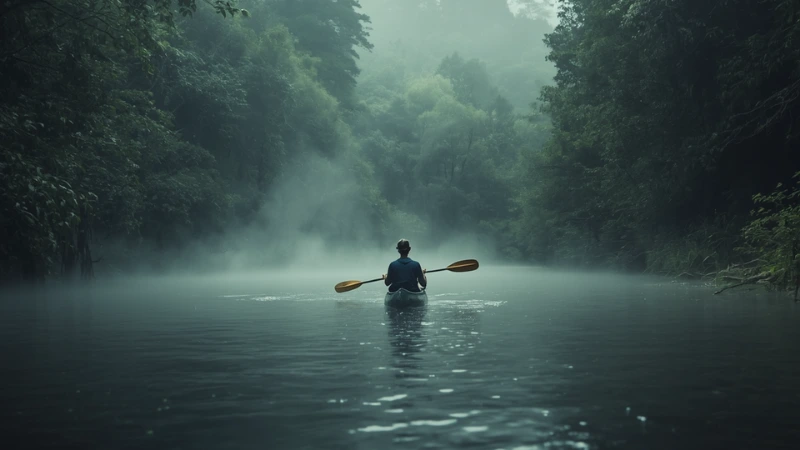
Think of a river upon which no cedar canoe had set foot for more than a hundred years. Not due to any changes in the river; it hadn’t. Nor had all knowledge of building and using canoes been lost. Rather, a concerted effort had been undertaken by colonial policies to break the people’s connection with the river, and via the river, themselves.
In 2017, after a period of over one hundred years, four adults and five youth from the Anishinaabe First Nation community of Biigtigong Nishnaabeg embarked on a paddle down the Biigtig Ziibii, or the river they traditionally inhabit. What is remarkable about this particular trip is not only that it happened at all, but what scientific research was conducted during the trip.
Water, Land, and the Architecture of Wellbeing.
Within Western biomedicine, the connection between individuals and their natural surroundings can be considered a backdrop. Within many Indigenous frameworks of medicine, this connection is not a backdrop at all; rather, it forms the basis for the entire system.
The work of Jennifer Redvers, published in the journal International Journal of Indigenous Health, was based on interviews with eleven land-based healing practitioners in Canada’s three northern territories: Yukon, Northwest Territories, and Nunavut. These land-based healers did not present their practices as any form of program or service. Instead, they saw land-based healing as a process that inherently involved a relationship with the land, where the land and the water were not merely a place where healing occurred but were actively engaged with in the process. Cultural identity was not something that one brought to water but was made through it.
This notion is further corroborated by Acharibasam et al. (2024) in their paper published in the EXPLORE journal, where they collaborated with Ministikwan Lake Cree Nation in Saskatchewan to investigate how land-based healing relates to water governance. The conclusions they reached were clear: disconnecting from both land and water within this community was not just an issue of lack of accessibility or geography but a disconnect from the cultural spirituality and ways of knowing upon which healing is built. Engaging again in culturally relevant activities centred on reconnecting with water had significant repercussions for the well-being of the community beyond what any clinical treatment could achieve.
Paddling the Biigtig: A Peer-Reviewed Story of Return.
This event did not only serve as an example of community life, but it was also analyzed by Kayla Mikraszewicz and Chantelle Richmond in their paper in the journal Social Science & Medicine. These authors conducted interviews with the participants and discovered what kind of health effects the Biigtigong Nishnaabeg River Journey had produced.
There were three important themes discussed by the researchers in their analysis. The first one concerns the role that the journey played in the transmission of Indigenous Knowledge. Specifically, Mikraszewicz and Richmond noted that “portages [along the route] had names said out loud in Anishinabemoen; youth heard the history of certain bends in the river for the first time in their lives, and they experienced the reclamation of the story behind each landmark that was being passed during the journey.” The second theme concerned the development of social relations between the Elders and the youth. This process was achieved in ways that could not be reached by any other institution, such as a school, municipality, or even a health care institution. The last theme involves the personal connection with place that was developed among the younger participants of the event.
All of these were discussed within the context of the Anishinaabe tradition of mino bimaadiziwin (living a good and healthy life). As articulated by the authors, this particular journey of the canoe was no reenactment of the past; rather, it was an enactment of philosophy itself.
A related study conducted by Nightingale & Richmond in the International Journal of Environmental Research and Public Health examined another camp experience led by the same Biigtigong Nishnaabeg community in 2019. This time, the camp took place at Mountain Lake – a culturally important site from which the community had been removed for several decades. This particular camp involved the participation of fifteen members of different ages: Elders, youth, and band staff members. As found in the thematic analysis of their story-based interviews, the camp allowed for the development of better relationships among the community members, the practice of Anishinaabe knowledge, and pride in their community. For instance, one of the youth expressed amazement in arriving at the ancestral lands that others did not care much about: “It was really interesting seeing how much we have to ‘fight for’ there.”
The Canoe Journey as a Health Intervention: Pacific Northwest Evidence.
In addition to community-specific research conducted in Canada, this same theme of healing is investigated in other health-based research that takes place further down the Pacific coast. “Healing of the Canoe,” an intervention developed at the Alcohol and Drug Abuse Institute of the University of Washington in collaboration with the two Pacific Northwest tribes of Suquamish and Port Gamble S’Klallam Tribes.
Donovan et al. publish their work on this program in the American Indian and Alaska Native Mental Health Research, which utilizes the annual event of the Tribal Canoe Journey – wherein canoes from different Indigenous Nations from the coasts of Alaska, BC, Washington, and Oregon meet each year – as both a metaphorical and tangible practice for cultural interventions aimed at preventing substance abuse among high school age adolescents.
In addition, the participants in the program expressed increased levels of hope, optimism, and self-efficacy, decreased substance use, and increased levels of cultural identification and understanding of alcohol and drug issues. Significantly, it should be highlighted that the described intervention did not only imply the participation in the tribal canoe ride, but that the participants devoted themselves to preparation for this event for a whole year and lived substance-free lives during this time.
It was stressed by the authors that the actual Tribal Canoe Journey is, first of all, an event that restores the strong maritime identity of the Coast Salish people, whose lives were tightly connected with the canoes – a means of fishing, communication, trade, and spirituality of this culture. The young participants are taught how to navigate in deep waters under challenging conditions; how to resolve any conflicts that might arise during their joint stay.
Traditional Activity and Holistic Wellness: What Systematic Research Finds.
These results are embedded within the larger literature on this topic. Akbar, Zuk, and Tsuji conducted a systematic review in the International Journal of Environmental Research and Public Health on the impacts on health and wellness of traditional physical activities, such as canoeing, on Indigenous youth in Canada, the United States, New Zealand, and Australia. In doing so, Akbar et al. employed an integrated Indigenous ecological theory that structures the results into the dimensions of health and wellness, intrapersonally, interpersonally, organizationally, communally, and policy-wise, utilizing the medicine wheel as an organizing theory.
Indeed, the results of their analysis, which were drawn from nine independent studies, were consistent throughout: traditional physical activities engaged in by Indigenous youth resulted in both physiological and psychosocial benefits, ranging from improvements in physical fitness and physical self-concept to an increase in cultural identity, intergenerational connections, and engagement with community. However, most importantly, it was observed that the participants did not regard the activities as exercise at all, but rather as life, as part of their daily routine and identity.
It is important because it highlights an aspect of the practice of wellness which is often overlooked by standard theories of health promotion; that is, the practice of wellness through traditional processes, such as journeying by canoe, is not achieved because of physical activity alone, but because of all those other things which are done at the same time.
Cultural Continuity as a Determinant of Health: A Canadian Foundation.
Beyond these particular studies lies a more fundamental and established finding within Canadian Indigenous health research. In 1998, two psychologists, Michael Chandler and Christopher Lalonde, wrote a seminal paper on the issue of Indigenous youth suicide rates among nearly 200 First Nations bands located in the province of British Columbia.
Their finding was one of extraordinary variability. Although youth suicide rates among Canada’s Indigenous population were significantly higher than in other parts of the country, the national figure did not do justice to the complexity of the situation, according to Chandler and Lalonde. Instead of reflecting some sort of uniform pattern of youth suicides across different communities in BC, their data showed that some Indigenous communities experienced rates hundreds of times greater than others. Yet these rates were not randomly determined but were systematically related to what Chandler and Lalonde referred to as cultural continuity.
It doesn’t imply that travelling by canoes prevents suicides, as the connection between cultural integrity and psychological well-being is far more complicated and dependent upon individual communities. What the finding proves is that cultural activities and indigenous self-determination, as practiced through the act of canoe travelling, are no longer seen as a marginal aspect of health but rather a significant determinant thereof.
The River Has Always Known the Way.
There is an exact knowledge that can only be passed down from person to person when one is on the water – the name of a particular rapid in the language of the people who have used it for ten thousand years, how to understand a current, the history of those who were lost at a particular portage and those who lived through it and why. When colonial policy cut off the passing of such knowledge for decades, it wasn’t just interfering in a cultural tradition. Rather, as recent peer-reviewed studies have shown, it was disrupting a practice of healing.
Reconnecting with the canoeing tradition in places like Biigtigong Nishnaabeg in Ontario or the Suquamish and Port Gamble S’Klallam peoples of the Pacific Northwest does not constitute cultural reminiscing. It is neither a cultural tour nor a healing program. It is a grassroots effort of restoration that the data suggests leads to significant positive effects on mental health, cultural awareness, family relations, and the health of children and young adults. The river has always been the healer; only recently has the research begun to confirm it.
Key Takeaways.
Sources.
Mikraszewicz, K., & Richmond, C. (2019). Paddling the Biigtig: Mino biimadisiwin practiced through canoeing. Social Science & Medicine, 240, 112548. https://doi.org/10.1016/j.socscimed.2019.112548
Nightingale, E., & Richmond, C. (2022). Reclaiming land, identity and mental wellness in Biigtigong Nishnaabeg territory. International Journal of Environmental Research and Public Health, 19(12), 7285. https://doi.org/10.3390/ijerph19127285
Redvers, J. (2020). “The land is a healer”: Perspectives on land-based healing from Indigenous practitioners in northern Canada. International Journal of Indigenous Health, 15(1), 90–107. https://doi.org/10.32799/ijih.v15i1.34046
Acharibasam, J. B., Hurlbert, M., Datta, R., & Lewis, K. w. (2024). Meanings of Indigenous land-based healing and the implications for water governance. EXPLORE, 20(4). https://doi.org/10.1016/j.explore.2024.04.002
Donovan, D. M., Thomas, L. R., Sigo, R. L. W., Price, L., Lonczak, H., Lawrence, N., Ahvakana, K., Austin, L., Lawrence, A., Price, J., Purser, A., & Bagley, L. (2015). Healing of the canoe: Preliminary results of a culturally tailored intervention to prevent substance abuse and promote tribal identity for Native youth in two Pacific Northwest tribes. American Indian and Alaska Native Mental Health Research, 22(1), 42–76. https://doi.org/10.5820/aian.2201.2015.42
Akbar, L., Zuk, A. M., & Tsuji, L. J. S. (2020). Health and wellness impacts of traditional physical activity experiences on Indigenous youth: A systematic review. International Journal of Environmental Research and Public Health, 17(21), 8275. https://doi.org/10.3390/ijerph17218275
Chandler, M. J., & Lalonde, C. (1998). Cultural continuity as a hedge against suicide in Canada’s First Nations. Transcultural Psychiatry, 35(2), 191–219. https://doi.org/10.1177/136346159803500202
Note on Language: This article uses the terms First Nations, Anishinaabe, Anishinabemoen, and mino bimaadiziwin with reference to specific communities and research sources cited. The diversity of Indigenous nations, languages, and healing traditions across Canada and beyond cannot be generalized.
Disclaimer.
This article is for informational and educational purposes only and does not constitute medical advice. It should not be taken as a medical diagnosis or treatment.
Always consult with a qualified healthcare professional for personalized medical guidance.
This article references research on youth suicide and mental health outcomes. If you or someone you know is experiencing mental health challenges, please reach out to a healthcare provider or contact the Hope for Wellness Help Line at 1-855-242-3310, available 24 hours a day, 7 days a week, to Indigenous peoples across Canada.
- Share

Magazica Editorial Team
Magazica is a dedicated platform for businesses, subject matter experts, health advocates, and various sectors within the health industry. At Magazica, we are committed to sharing the latest health information and developments with our audience. We serve as a gateway for health-related businesses to showcase their progress and advancements, demonstrating how they contribute to enhancing people's wellness.
Elderly Care with Empathy: Dr. Anthony Di Cintio on Bringing Back Medical House Calls
An eighty-eight-year-old man stands in his living room. Tired, near the end of his life. He asks his wife for one....
Nature’s Unlabelled Aisle: What Late-Summer Foraging Asks of You Before You Eat Anything
Late-summer foraging explained: why there is no shortcut test, what apps get wrong, how the knowledge is really learned...
Saving Lives Before Symptoms Strike: How Dr. David Messika‑Zeitoun Is Transforming Heart Valve Care in Canada
Dr. David Messika-Zeitoun is a global leader in valvular heart disease, combining scientific precision with deeply...
Community Gardens: Cultivating Food and Neighbourhood Bonds
On a sunny Saturday morning in many Canadian neighbourhoods, a community garden is one of the liveliest places...
Living Fully, Caring Deeply: Kirsten Woodend on Nursing, Loss, Resilience, and the Power of Human Connection
Some people spend a lifetime mastering a craft. Others spend a lifetime mastering what it means to be human...
Breaking the Stigma: Community Initiatives for Youth Mental Health in Canada
There is a quiet crisis unfolding in communities across Canada — one that doesn't always make the front page but...