The Peel Deal: What the Research Actually Says About Apple Season
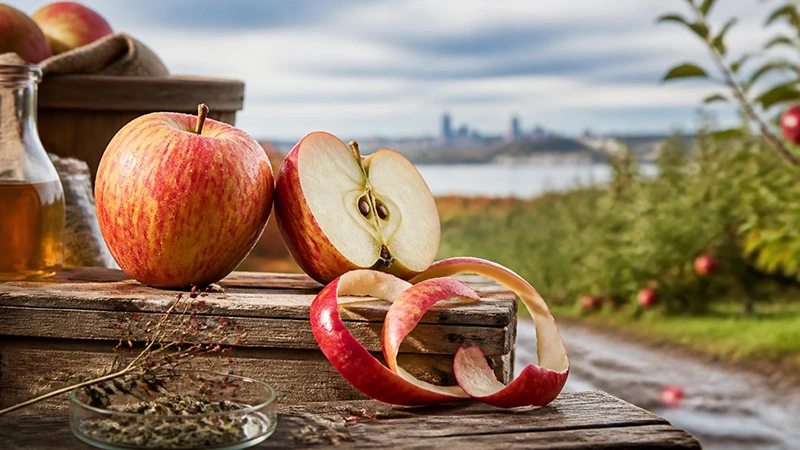
You’re at a farm stand somewhere north of the city in late September. The air smells like cold dirt and cider. Someone hands you a Honeycrisp; you wipe it on your sleeve, and a small voice in your head asks if you’re supposed to peel it.
Here’s the short version: the peel is the part you’d least want to throw away. Here’s the longer version, drawn only from peer-reviewed research.
Rust, But Make It Biological.
Every cell in your body burns fuel, and burning fuel throws off sparks. Scientists call those sparks reactive oxygen species — unstable molecules that react with other molecules and cause damage.
Your body has a cleanup crew for this. When the sparks outpace the crew, researchers call the imbalance oxidative stress. Hyson’s review notes that oxidative stress is understood to play a role in how most diseases develop, which is why food-based antioxidants get so much attention.
Antioxidants are, roughly, extra hands for the cleanup crew. Apples happen to carry a lot of them: Boyer and Liu identify quercetin, catechin, phloridzin, and chlorogenic acid as the main players, all of them strong antioxidants in laboratory testing.
Takeaway: An apple is a modest reinforcement for a system your body already runs. It’s a helpful input, not a fire extinguisher.
The Peel Is Doing the Heavy Lifting.
Think of the peel as the apple’s raincoat. It’s the part that faces the sun, the wind, and the insects, so it’s the part the tree armours most heavily.
The numbers back the metaphor. Analyzing fifteen old and new cultivars, Kschonsek and colleagues found quercetin glycosides concentrated in the peel at roughly 203 mg per 100 g, while the flesh’s phenolic acids came in at around 10 mg per 100 g.
When the team worked out which compounds drove antioxidant capacity, flavonols in the peel and vitamin C in the flesh were the leading contributors across every cultivar they tested. Worth flagging: that antioxidant capacity was measured in test tubes, not in people.
Takeaway: The research suggests peeling an apple removes its most polyphenol-dense layer. Wash it well and eat it whole.
Two Apples, Eight Weeks, Actual Humans.
Test-tube chemistry is one thing. Koutsos and colleagues ran the harder experiment: forty adults with mildly raised cholesterol ate two polyphenol-rich apples a day for eight weeks, then switched to a control drink matched for sugar.
During the apple weeks, total cholesterol, LDL cholesterol, and triglycerides were all lower than during the control weeks. A marker of blood-vessel “stickiness” also dropped, and the small vessels under the skin relaxed a little more readily.
The shifts were real but small — total cholesterol moved from about 6.11 to 5.89 mmol/L. Blood pressure and several other cardiovascular markers didn’t budge at all. The study observed a nudge, not a transformation.
Takeaway: The trial supports a modest cholesterol and blood-vessel benefit in people who already had mildly elevated cholesterol. Nobody in that study replaced anything with fruit.
Juice Is Not a Shortcut.
This is where it gets interesting for anyone who counts a glass of juice as a serving of fruit.
Ravn-Haren’s team put 23 healthy volunteers through five four-week stints: whole apples, apple pomace, cloudy juice, clear juice, or nothing. LDL cholesterol trended down with whole apples and pomace. With clear juice, it went up by nearly 7% compared with the whole-fruit periods.
The researchers concluded that the fibre component is necessary for the cholesterol-lowering effect, and that clear apple juice may not be a suitable stand-in for whole fruit in dietary recommendations. Clear juice is strained free of pectin and cell-wall material — you keep the sugar and lose the scaffolding.
Takeaway: The whole fruit and its juice behaved differently in this trial. If you like juice, drink it as juice, not as a substitute for the apple.
Your Apple Is Not My Apple.
Two apples in the same bin can carry meaningfully different polyphenol loads. Boyer and Liu report that composition varies greatly between varieties, with only small shifts as fruit ripens.
Hyson adds growing region, season, and storage to the list of influences. And here’s the reassuring part from Boyer and Liu: storage itself has little to no effect on apple phytochemicals, while processing can change them considerably.
So the apple that sat in your crisper for two weeks is broadly fine. The apple that got peeled, cooked into a clear syrup, and strained is a different food.
Takeaway: Chasing the “highest-antioxidant” cultivar is a poor use of your attention. Buying apples you’ll actually eat, peel included, is a better one.
The Rhyme Was Never a Prescription.
None of this research claims apples prevent or treat disease. What it observes is narrower and more useful: a common, cheap, in-season fruit carries compounds with measurable antioxidant activity, and eating it whole appears to do modest, good things to blood lipids in people whose numbers are drifting up.
That’s a reasonable thing to know in October, standing at a farm.
This article is for informational purposes only and does not constitute medical advice. Always consult with a qualified healthcare professional for personalized medical guidance.
References.
Boyer, J., & Liu, R. H. (2004). Apple phytochemicals and their health benefits. Nutrition Journal, 3, 5. https://doi.org/10.1186/1475-2891-3-5
Hyson, D. A. (2011). A comprehensive review of apples and apple components and their relationship to human health. Advances in Nutrition, 2(5), 408–420. https://doi.org/10.3945/an.111.000513
Koutsos, A., Riccadonna, S., Ulaszewska, M. M., Franceschi, P., Trošt, K., Galvin, A., Braune, T., Fava, F., Perenzoni, D., Mattivi, F., Tuohy, K. M., & Lovegrove, J. A. (2020). Two apples a day lower serum cholesterol and improve cardiometabolic biomarkers in mildly hypercholesterolemic adults: A randomized, controlled, crossover trial. The American Journal of Clinical Nutrition, 111(2), 307–318. https://doi.org/10.1093/ajcn/nqz282
Kschonsek, J., Wolfram, T., Stöckl, A., & Böhm, V. (2018). Polyphenolic compounds analysis of old and new apple cultivars and contribution of polyphenolic profile to the in vitro antioxidant capacity. Antioxidants, 7(1), 20. https://doi.org/10.3390/antiox7010020
Ravn-Haren, G., Dragsted, L. O., Buch-Andersen, T., Jensen, E. N., Jensen, R. I., Németh-Balogh, M., Paulovicsová, B., Bergström, A., Wilcks, A., Licht, T. R., Markowski, J., & Bügel, S. (2013). Intake of whole apples or clear apple juice has contrasting effects on plasma lipids in healthy volunteers. European Journal of Nutrition, 52(8), 1875–1889. https://doi.org/10.1007/s00394-012-0489-z
- Share

Magazica Editorial Team
Magazica is a dedicated platform for businesses, subject matter experts, health advocates, and various sectors within the health industry. At Magazica, we are committed to sharing the latest health information and developments with our audience. We serve as a gateway for health-related businesses to showcase their progress and advancements, demonstrating how they contribute to enhancing people's wellness.

The Toll Booth and the Meter: What Canning and Freezing Actually Cost Your Vegetables
What canning and freezing really do to nutrients, why heat sometimes helps, and the acidity rule that keeps...
Farmers’ Market Feasts: Maximizing Local Summer Produce
There is a moment in the Canadian summer—brief, golden, and intensely flavourful—when the farmers' market becomes...
Hydration Hacks: Beyond Plain Water for Summer Sweat Sessions
Canada's summers pack a punch. From the humidity of southern Ontario to the dry heat rolling across the Prairies...
Plant-Based Proteins: Fueling Muscle Recovery Naturally
Whether you're a weekend cyclist, a hockey player recovering from hard practice, or a gym-goer trying to...
The Gut-Brain Connection: How Early Spring Produce Feeds Your Mood
Do you feel weird this time of year? Canadian asparagus, peas, and rhubarb can fix that. You know that feeling...
Mindful Eating 101: Slowing Down, Chewing Thoroughly and Telling True Hunger From Emotional Cravings
In a world of constant multitasking and rushed meals, many of us finish a plate before our brains have even...