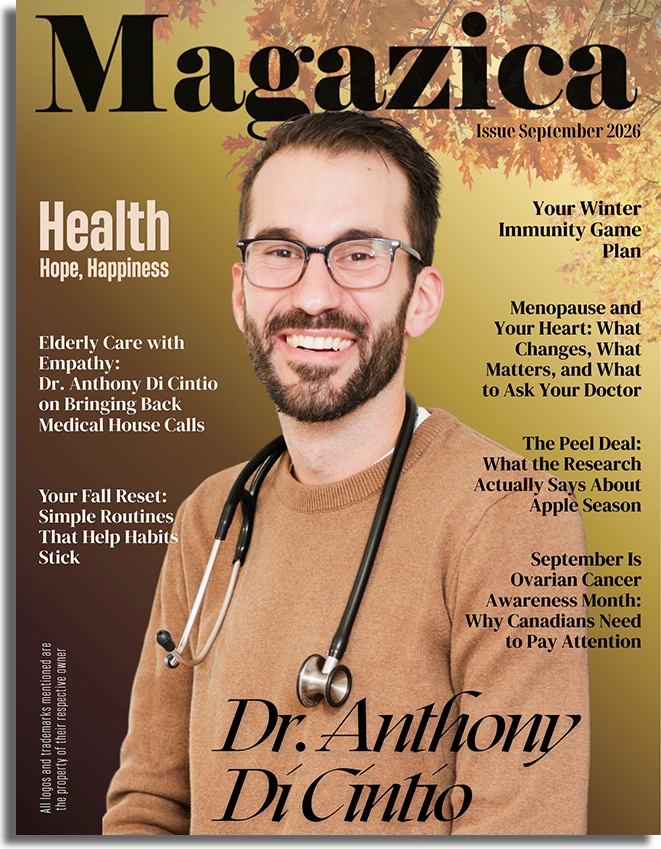

Menopause and Your Heart: What Changes, What Matters, and What to Ask Your Doctor
Heart disease has a reputation problem in Canada: too many people still picture it as a man’s disease. But it remains the leading cause of premature death for Canadian women, and one of the biggest shifts in risk often arrives in midlife. During perimenopause and menopause, changes in estrogen can make heart health a more urgent conversation — not a distant concern, but something worth bringing into the exam room now.
What Happens When Estrogen Starts to Dip.
For much of a woman’s reproductive life, estrogen works quietly in the background, offering some protection for the heart and blood vessels. The Menopause Foundation of Canada puts it simply: before menopause, estrogen helps protect against heart disease. As estrogen levels fall through menopause, that protection fades, and the risk of conditions such as heart disease begins to rise.
That shift does not happen all at once, and it does not happen in isolation. The Heart and Stroke Foundation of Canada explains that, as estrogen production declines during perimenopause and menopause, the risk of heart disease and stroke can increase. After menopause, estrogen’s heart-protective effects are largely gone — just as the ordinary effects of aging are also beginning to play a bigger role.
Cardiologist Dr. Karin Humphries, at the University of British Columbia, sees menopause as one of the key life stages that can reveal a woman’s future heart risk — alongside pregnancy. In simple terms, when estrogen levels fall, one layer of cardiovascular protection recedes, and other age-related risks can become easier to see.
When “Just Menopause” May Be More Than That.
One of the most worrying patterns researchers have identified is how often real heart-health warning signs are brushed aside as “just menopause.” A review in CJC Open, a journal of the Canadian Cardiovascular Society, notes that vasomotor symptoms — hot flashes, night sweats, and cold sweats — are linked with cardiovascular risk factors, yet they are often mistaken for stress or treated as routine menopausal discomfort. The same research notes that changes in blood-vessel function can begin early in menopause, before other signs of heart disease are easy to detect.
The problem is not only that symptoms can be dismissed in the moment. Menopause itself often receives too little attention in regular healthcare conversations. Physicians at Women’s College Hospital in Toronto, an academic hospital focused on women’s health, have noted that too few women are asked about menopausal symptoms or told about treatment and monitoring options — even though this transition can be both debilitating and medically important.
Rethinking the Hormone Therapy Conversation.
Hormone therapy has carried a cloud of fear for years. Much of that concern traces back to a study from the early 2000s that linked hormone therapy with higher risks of heart disease, stroke, and breast cancer. Prescriptions dropped sharply, and for many women the takeaway became simple: hormone therapy was dangerous.
But that story has become more nuanced. Women’s College Hospital physicians Dr. Iliana Lega and Dr. Michelle Jacobson have pointed to an important detail that was often lost: age matters. When the original data was re-analyzed by age group, the higher risks of stroke and heart disease appeared mostly among women who started hormone therapy after age 60. For women closer to the usual age of menopause — roughly 50 to 60 — hormone therapy has not been linked with increased heart disease risk, and current evidence suggests it may even be protective during that window.
This nuance matters because it reframes hormone therapy not as a blanket risk, but as a decision that depends heavily on timing and individual health context — a conversation best had directly with a physician familiar with current research, rather than outdated general assumptions.
Small Everyday Steps That Help Protect Your Heart.
The good news is that many of the most important heart-health steps are everyday ones. Canadian cardiovascular experts point to blood pressure, diabetes, smoking, and physical inactivity as risk factors that can have an especially strong impact on women’s heart health, according to the Heart and Stroke Foundation. Regular movement — even short, steady sessions — can help address several risks at once, while also supporting sleep, mood, and energy during the menopausal transition.
Researchers are also trying to spot the heart-health changes of menopause earlier. The Heart and Stroke Foundation recently helped fund a major international study looking at how menopause affects the heart and arteries, with a focus on detecting quiet changes during perimenopause. The hope is to shift care toward earlier prevention, before symptoms or damage have already appeared.
The Heart-Health Talk Worth Having.
For Canadian women moving through perimenopause and menopause, the message is straightforward: this is not only a hormonal milestone, but a heart-health one. Hot flashes, sleep disruption, and other menopausal symptoms may deserve more attention than they often receive. Asking a healthcare provider directly about heart health during this stage is not overreacting — it is a practical step toward protecting long-term health.
Sources.
- Heart and Stroke Foundation of Canada — “Women’s risk factors” https://www.heartandstroke.ca/women/womens-risk-factors
- Heart and Stroke Foundation of Canada — “Pregnancy to menopause: the heart and brain health connection” https://www.heartandstroke.ca/articles/pregnancy-to-menopause-the-heart-and-brain-health-connection
- Women’s College Hospital — “Managing Menopause: A new review by WCH physicians” https://www.womenscollegehospital.ca/managing-menopause-a-new-review-by-wch-physicians/
- Menopause Foundation of Canada https://menopausefoundationcanada.ca/
- CJC Open (Canadian Cardiovascular Society) — “Women’s Heart Health and the Menopausal Transition: Two Faces of the Same Coin” https://www.cjcopen.ca/article/S2589-790X(23)00288-3/fulltext
- Share

Magazica Editorial Team
Magazica is a dedicated platform for businesses, subject matter experts, health advocates, and various sectors within the health industry. At Magazica, we are committed to sharing the latest health information and developments with our audience. We serve as a gateway for health-related businesses to showcase their progress and advancements, demonstrating how they contribute to enhancing people's wellness.

Splash Safely: Why Your Skin and Ears Might Throw a Summer Tantrum
Think about the ideal day out by the lake. The cooler is packed, you've found the perfect spot to lie on the beach, and now...

Men’s Health Checklist: Screenings You Shouldn’t Ignore This Year
For decades, Canadian men have embraced a "if it isn't broken, don't fix it" approach to health. “As a man, I can...
Come Together: Canadian Mental Health Week, May 4–10
Every May, something important happens across Canada. In schools, workplaces, community centres, and...

Eyes in the Digital Age: How the 20-20-20 Rule Can Ease Strain and Headaches
Staring at screens is a defining feature of modern life. Whether working from home or scrolling through social media...

Land as Medicine: How Reconnecting with Traditional Territories Heals Indigenous Youth
For countless generations, Indigenous Peoples have understood what Western science is only beginning to confirm...

The Canine Cleanup Crew: How Dogs’ Outdoor Adventures May Shape Our Microbiome and Immune System
When your dog charges back into the house after chasing squirrels or splashing through puddles, it picks up soil- and...