
The Study Station Nobody Sells You
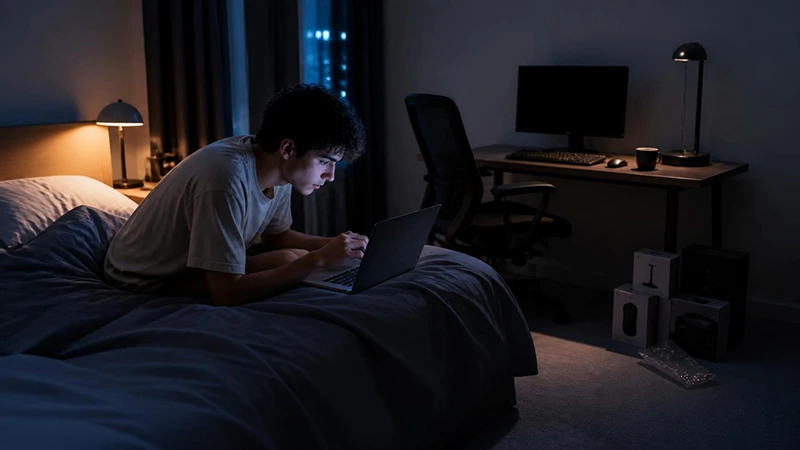
It’s 1 a.m. You’re in bed, laptop balanced on a duvet, chin tucked toward your chest like you’re reading the fine print on a contract you already signed. Somewhere in a drawer is a $200 ergonomic mouse you bought in September and used twice.
Here’s the surprising part. The most rigorous review of this whole field is far less impressed by that mouse than the ads were.
First, the Bad News for the Gadget Industry.
Andersen and colleagues screened 1,349 review titles and kept 17 systematic reviews on computer work and upper-body problems. Their conclusion was blunter than you’d expect.
They found moderate-to-high quality evidence linking intensive keyboard and mouse use to acute or short-lived pain complaints, though whether that link is causal remains unsettled. For specific diseases or chronic pain, they found no evidence at all.
And the line that should reshape your shopping list: they reported no effect from preventive interventions consisting only of workstation adjustments. Limited evidence supported combining ergonomics training with those adjustments.
Buying the chair is like buying running shoes. The shoes aren’t the running.
Takeaway: The review suggests gear alone doesn’t do much. Gear plus actually knowing how to use it is where the thin evidence points.
The Cheapest Fix Is a Stack of Textbooks.
A laptop is a compromise machine. Screen and keyboard are welded into one object, so wherever you put it, one of them is wrong. Screen at eye level means keyboard at chin height. A comfortable means screen in your lap.
Yadegaripour and colleagues tested the obvious solution on 20 young men doing typing and mouse tasks: raise the laptop on a riser, plug in a separate keyboard.
The adjusted setup reduced cervical flexion by about 4.5 degrees and thoracic flexion by roughly 3 degrees. Activity in two back-of-neck and spine muscles dropped by about 10% and 16%, respectively, and participants reported less discomfort.
Modest numbers, tiny sample, eight-minute sessions. But the fix costs whatever a used textbook weighs plus a cheap keyboard.
Takeaway: Separating the screen from the keys is the one hardware change with measurable posture and muscle effects behind it.
Breaks Are Not Procrastination With Better PR.
Albulescu and colleagues pooled 22 study samples covering 2,335 people to ask whether micro-breaks – stopping a task for ten minutes or less – actually help.
They do, modestly. The meta-analysis found small but statistically significant improvements in vigour and reductions in fatigue. Effect sizes were genuinely small; this is a nudge, not a transformation.
Performance was messier. The authors concluded that recovering from highly depleting tasks may require more than ten minutes, which is a polite scientific way of saying a two-minute stretch won’t rescue you from hour six of organic chemistry.
Takeaway: Short breaks have decent support for how you feel. Whether they rescue your output depends on how hard the work was to begin with.
The 20-20-20 Rule Is Currently Having an Argument.
You’ve heard it: every 20 minutes, look at something 20 feet away for 20 seconds. It’s on every optometry poster in the country. The evidence is livelier than the poster suggests.
Talens-Estarelles and colleagues installed webcam-based software on the laptops of 29 symptomatic computer users to track breaks and blinking and prompt them. Over two weeks, participants took more breaks and reported improvements in digital eye strain and dry eye. One week after the reminders stopped, the gains hadn’t held.
Then Johnson and Rosenfield ran a tighter test: 30 people, a 40-minute demanding reading task on a tablet, with 20-second breaks every 5, 10, 20 or zero minutes. Symptoms climbed during every session, and the breaks made no significant difference to symptoms, reading speed or accuracy.
The two studies aren’t quite measuring the same thing – two weeks of real life versus 40 minutes in a lab – but together they suggest the specific numbers may be less important than having something that actually makes you stop.
Takeaway: The rule’s exact arithmetic isn’t well supported. The prompt to look away from the screen may be doing the real work.
So What Do You Actually Build?
Nothing on this list requires a credit card, which is roughly the point.
Get the screen up on books so you’re not looking down at it. Plug in a separate keyboard so your hands can sit where hands like to sit. Set some kind of reminder to stop, and honour it. Then stop optimizing and go do the reading.
The research isn’t telling you your desk is dangerous. It’s telling you that most of what’s marketed as a solution hasn’t earned that description, and that the boring free adjustments are the ones with numbers attached.
If something already hurts, that’s a different conversation, and not one a riser resolves.
This article is for informational purposes only and does not constitute medical advice. Always consult with a qualified healthcare professional for personalized medical guidance.
References.
Albulescu, P., Macsinga, I., Rusu, A., Sulea, C., Bodnaru, A., & Tulbure, B. T. (2022). “Give me a break!” A systematic review and meta-analysis on the efficacy of micro-breaks for increasing well-being and performance. PLOS ONE, 17(8), e0272460. https://doi.org/10.1371/journal.pone.0272460
Andersen, J. H., Fallentin, N., Thomsen, J. F., & Mikkelsen, S. (2011). Risk factors for neck and upper extremity disorders among computer users and the effect of interventions: An overview of systematic reviews. PLOS ONE, 6(5), e19691. https://doi.org/10.1371/journal.pone.0019691
Johnson, S., & Rosenfield, M. (2023). 20-20-20 rule: Are these numbers justified? Optometry and Vision Science, 100(1), 52–56. https://doi.org/10.1097/OPX.0000000000001971
Talens-Estarelles, C., Cerviño, A., García-Lázaro, S., Fogelton, A., Sheppard, A., & Wolffsohn, J. S. (2023). The effects of breaks on digital eye strain, dry eye and binocular vision: Testing the 20-20-20 rule. Contact Lens and Anterior Eye, 46(2), 101744. https://doi.org/10.1016/j.clae.2022.101744
Yadegaripour, M., Hadadnezhad, M., Abbasi, A., Eftekhari, F., & Samani, A. (2021). The effect of adjusting screen height and keyboard placement on neck and back discomfort, posture, and muscle activities during laptop work. International Journal of Human–Computer Interaction, 37(5), 459–469. https://doi.org/10.1080/10447318.2020.1825204
- Share

Magazica Editorial Team
Magazica is a dedicated platform for businesses, subject matter experts, health advocates, and various sectors within the health industry. At Magazica, we are committed to sharing the latest health information and developments with our audience. We serve as a gateway for health-related businesses to showcase their progress and advancements, demonstrating how they contribute to enhancing people's wellness.
Blue Light Glasses: Fact or Fiction for Better Sleep?
As Canadians spend more time than ever staring at screens—with 72% clocking over 8 hours daily on digital devices...
Wearable Tech: Are Fitness Trackers Helping or Hurting Your Body Image?
“By the time you finish reading this sentence, your fitness tracker has likely logged another dozen steps.” In my own experience...
Ergonomics for the Hybrid Worker: Avoiding the Couch-Slouch
You're on a video call from your kitchen table, laptop propped on a stack of cookbooks, neck craned forward...

Digital Detox Weekends: Reclaiming Your Attention Span
So, if perusing your weekly screen time report is like binge-watching, well, you are certainly in good company...

Predictive Analytics in Public Health: Preventing Illness Before It Begins
A public health department identifies rising indicators of respiratory distress across a specific neighborhood...

The Predictive Mind: When Generative AI Learns to Anticipate Human Thought
Why Generative AI’s Next Evolution Is Anticipation, Not Automation. Medicine has always been...