
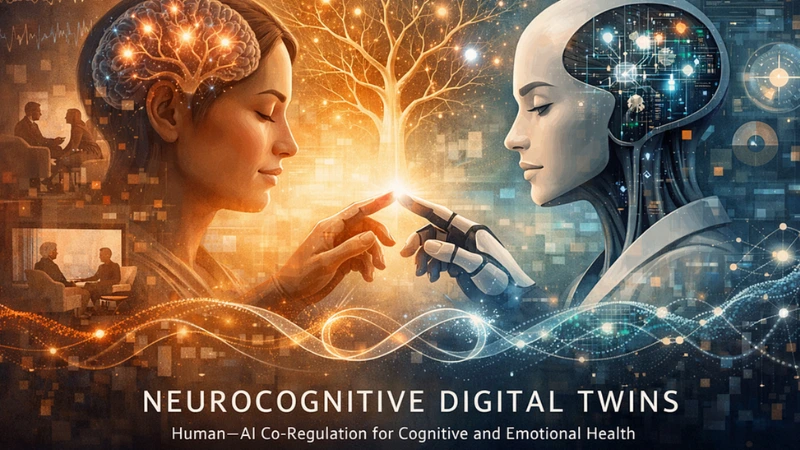
Neurocognitive Digital Twin: Human–AI Co-Regulation at the Intersection of GenAI, Psychotherapy, and Neurotherapy
Why Human–AI Co-Regulation, Not Automation, Will Define the Future of Psychotherapy.
Mental health care is entering a moment of quiet but profound transition.
Psychotherapy has always relied on something difficult to formalize, the clinician’s ability to sense, anticipate, and regulate emotional and cognitive states in another human being. This process is inherently predictive. Therapists continuously infer what a patient may be feeling next, where emotional escalation might occur, or when cognitive rigidity is about to surface. Regulation, not reaction, is the foundation of effective therapeutic work.
As Generative Artificial Intelligence enters mental health contexts, a critical question emerges, can AI support this regulatory process without replacing or distorting it?
The concept of the Neurocognitive Digital Twin offers one possible answer.
From Digital Records to Neurocognitive Representation.
Most digital mental health tools today remain descriptive rather than adaptive. They record symptoms, track sessions, or deliver scripted interventions. While useful, these tools largely ignore the dynamic and state dependent nature of human cognition and emotion.
A Neurocognitive Digital Twin represents a conceptual shift.
Rather than modeling a patient as a static profile, this approach seeks to maintain a continuously updated representation of an individual’s cognitive and emotional patterns, including stress responses, attentional states, affective volatility, and regulatory capacity. When paired with GenAI, such a representation allows systems to anticipate shifts in mental state rather than merely react to them.
This is not about prediction in the actuarial sense. It is about context aware anticipation, aligned with how clinicians already reason during therapy.
Human–AI Co-Regulation as the Core Principle.
The most important distinction in this model is that AI is not positioned as a therapist or decision maker. Instead, it functions as a co-regulatory system, supporting both patient and clinician.
In psychotherapy, regulation is bidirectional. Clinicians help patients regulate emotional states, while clinicians themselves must remain regulated to avoid cognitive bias, emotional contagion, or burnout.
Neurocognitive Digital Twins can support this shared regulatory space by:
- Detecting early indicators of emotional escalation or dissociation
• Identifying cognitive rigidity or rumination patterns
• Anticipating moments of therapeutic rupture
• Adjusting pacing and modality recommendations
• Supporting reflective practice for clinicians between sessions
The objective is not intervention automation. The objective is regulatory awareness.
Why This Aligns With Neuroscience.
Modern neuroscience increasingly characterizes the brain as a predictive and regulatory system, rather than a reactive one. Emotional regulation, executive function, and even perception itself are shaped by continuous forecasting and adjustment.
Psychotherapy works precisely because it engages these predictive mechanisms. Effective therapy does not wait for emotional collapse, it anticipates dysregulation and intervenes gently and early.
Neurocognitive Digital Twins mirror this logic.
By maintaining a living model of cognitive and emotional dynamics, GenAI systems can align with therapeutic reasoning rather than disrupt it. This alignment is critical for trust. Clinicians are unlikely to adopt systems that feel intrusive, prescriptive, or cognitively alien.
They are more likely to engage with tools that behave like thoughtful collaborators.
Clinical Value Without Clinical Authority.
One of the most significant risks in applying GenAI to mental health is the illusion of authority. Systems that appear empathic or confident can inadvertently encourage over reliance, particularly among vulnerable patients.
For this reason, Neurocognitive Digital Twins must remain explicitly non authoritative.
Their role is to inform, not decide.
To surface patterns, not diagnoses.
To support judgment, not replace it.
Clear design boundaries are essential. These systems should never provide independent therapeutic direction, nor should they operate without clinician oversight in clinical settings.
Co-regulation, by definition, preserves human responsibility.
Ethical and Clinical Safeguards.
The introduction of anticipatory AI into psychotherapy raises legitimate ethical concerns, particularly around privacy, bias, and psychological safety. Neurocognitive representations are deeply sensitive. Misuse or misinterpretation could cause harm.
Responsible implementation requires:
Importantly, these safeguards are not technical add ons. They are clinical requirements.
A Post-Pandemic Context That Matters.
The relevance of this model is amplified by post pandemic realities. Rates of anxiety, depression, trauma related disorders, and clinician burnout have risen sharply. At the same time, access to mental health professionals remains constrained.
AI will inevitably play a role in addressing this gap. The critical question is how.
Automation driven approaches risk commodifying care. Co-regulatory approaches aim to amplify human capacity without eroding therapeutic integrity.
Neurocognitive Digital Twins offer a framework for doing so responsibly.
Implications for Mental Health Systems.
If adopted thoughtfully, this approach could reshape how mental health services scale while preserving quality.
Potential system level benefits include:
• Reduced clinician cognitive load
• Earlier detection of deterioration
• Improved continuity of care
• Support for reflective clinical practice
• Better alignment between digital tools and therapeutic models
These benefits emerge not from replacing therapists, but from supporting the cognitive and emotional labor that therapy demands.
Augmentation Through Co-Regulation.
Mental health care does not need artificial therapists. It needs artificial systems that respect human psychology.
The Neurocognitive Digital Twin is best understood not as a product, but as a design philosophy. It recognizes that psychotherapy is a regulatory practice, grounded in anticipation, empathy, and judgment. GenAI can support this practice only if it is designed to co-regulate rather than command.
The future of AI in mental health will not be defined by how convincingly it mimics empathy, but by how carefully it supports human regulation.
In this domain, restraint is not a limitation … It is a clinical virtue.
References
- Torous J, Bucci S, Bell IH, et al.
The growing field of digital psychiatry, current evidence and the future of apps, social media, chatbots, and virtual reality.
World Psychiatry. 2021;20(3):318–335. - Patel VL, Shortliffe EH, Stefanelli M.
The coming of age of artificial intelligence in medicine.
Artificial Intelligence in Medicine. 2022;126:102277. - Singhal K, Azizi S, Tu T, et al.
Large language models encode clinical knowledge.
Nature. 2023;620:172–180. - Blease C, Bernstein MH, Gaab J, et al.
Chatbots in mental health care, ethical, clinical, and epistemic considerations.
Journal of Medical Ethics. 2023;49(7):447–455. - Liu X, Glocker B, McCradden MM, et al.
Reporting guidelines for clinical trials evaluating artificial intelligence interventions.
Nature Medicine. 2023;29:1631–1638. - Reddy S, Allan S, Coghlan S, Cooper P.
A governance model for the application of AI in health care.
The Lancet Digital Health. 2024;6(2):e72–e80. - Sendak MP, Gao M, Nichols M, et al.
Human centered design of machine learning models for clinical decision support.
NPJ Digital Medicine. 2022;5:1–8. - Topol EJ.
High performance medicine, the convergence of human and artificial intelligence after COVID-19.
Nature Medicine. 2022;28(9):1800–1809. - World Health Organization.
Ethics and governance of artificial intelligence for health.
World Health Organization; 2021. - U.S. Food and Drug Administration.
Artificial intelligence and machine learning enabled medical devices, update and action plan.
U.S. Food and Drug Administration; 2023. - Torous J, Keshavan M.
The role of generative artificial intelligence in mental health care.
The Lancet Psychiatry. 2023;10(8):553–554. - Obermeyer Z, Powers B, Vogeli C, Mullainathan S.
Dissecting racial bias in an algorithm used to manage the health of populations.
Science. 2019;366(6464):447–453.
- Share

Dr. Arman Kamran
Arman Kamran is an enterprise transformation strategist and Multi-Agent Generative AI innovator with over two decades of experience leading automation-driven modernization across healthcare, government, financial services, and telecommunications. A member of the Harvard Business Review Advisory Council, Harvard Digital Data Design Institute (D³), and the Amazon Web Services Customer Experience Council, Arman operates at the intersection of intelligent automation, neuroscience-inspired design, and digital system transformation. He has led some of Canada’s most complex data-driven modernization programs, including the Ontario Panorama and Ontario Laboratory Information System (OLIS) initiatives—defining blueprints for interoperability, regulatory compliance, and scalable public-health platforms. Nationally, he also guided the Federal Data Hub and its AI-powered fraud-detection engine, and most recently architected an Integrated Healthcare GenAI Automation Solution that blends multi-agent intelligence, patient logistics, and cognitive augmentation across clinics and dispatch networks. A former early Certified Scrum Master, Arman has evolved beyond methodology to pioneer agentic augmentation frameworks—where autonomous AI agents act as cognitive collaborators across delivery ecosystems. His current research and implementation work focus on enabling self-organizing, neuro-adaptive enterprise systems that unite human decision-making with AI-driven precision. Arman is also a university educator, teaching transformative technology at the University of Texas, and a prolific author and speaker on Gen AI-enabled transformation, AI ethics, and the future of intelligent operations.

Blue Light Glasses: Fact or Fiction for Better Sleep?
As Canadians spend more time than ever staring at screens—with 72% clocking over 8 hours daily on digital devices...
Wearable Tech: Are Fitness Trackers Helping or Hurting Your Body Image?
“By the time you finish reading this sentence, your fitness tracker has likely logged another dozen steps.” In my own experience...

Ergonomics for the Hybrid Worker: Avoiding the Couch-Slouch
You're on a video call from your kitchen table, laptop propped on a stack of cookbooks, neck craned forward...

Digital Detox Weekends: Reclaiming Your Attention Span
So, if perusing your weekly screen time report is like binge-watching, well, you are certainly in good company...

Predictive Analytics in Public Health: Preventing Illness Before It Begins
A public health department identifies rising indicators of respiratory distress across a specific neighborhood...

The Predictive Mind: When Generative AI Learns to Anticipate Human Thought
Why Generative AI’s Next Evolution Is Anticipation, Not Automation. Medicine has always been...