
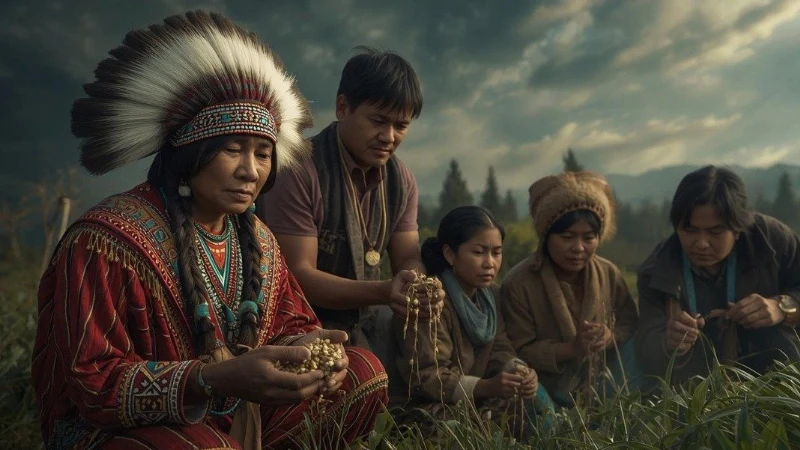
Canadian Indigenous Seed Saving: Preserving Culture and Food Security
For thousands of years, Indigenous peoples have been the original seed keepers of this land. Today, communities across Canada are reclaiming that role—one seed at a time.
My first-year gardening, I bought a packet of tomato seeds from a big box store. They grew fine. But last summer, a friend who is Mohawk from Six Nations handed me a small envelope. Inside were corn seeds—her family’s corn, grown on the same land for generations. She said,
“These have stories. Listen to them.”
I planted them— I understood.
That is what seed saving is about. Not just growing food. Holding memory.
The Original Seed Keepers.
Long before seed catalogues arrived in the mail, Indigenous seed keepers collected saved and shared seeds from the plants that sustained them. For generations, First Nations, Inuit, and Métis peoples across Turtle Island carried a tradition that sustained them and their culture.[5].
These weren’t just seeds. They were medicine. Food. Memory.
Robin Wall Kimmerer, the celebrated Indigenous author and botanist, once wrote: “In some Native languages, the term for plants translates to ‘those who take care of us'” [5]. That relationship—plants taking care of us, and us taking care of plants—is at the heart of Indigenous seed saving.
A seed is not a commodity. It is a relative. A gift. A promise.
“Seeds carry stories, language and the taste of home.”
What Is Seed Sovereignty?
Seed sovereignty is the right to save, use, and share seeds. For Indigenous communities, it goes deeper: it is about cultural survival.
As researchers from the University of Manitoba explain, food sovereignty for Indigenous peoples is a necessary struggle for cultural survival. Many communities live in conditions shaped by colonial policies that disrupt traditional food systems [4].
But communities are fighting back—with seeds.
Seeds of Change: Stories from Across Canada.
Mohawk Seedkeeper Gardens (Six Nations, Ontario).
In Ohsweken, Ontario, Terrylynn Brant runs Mohawk Seedkeeper Gardens. For more than seven years, she has created a space where community members reconnect with the land through traditional Haudenosaunee practices: gardening, heritage seed saving, and native plant foraging [2].
Her newly launched Indigenous Food Trees Project is working to revitalize Haudenosaunee land management by re-establishing native food trees and removing invasive species that threaten traditional foraging grounds [2].
The Braiding Food Systems Project (Northern Ontario).
In Northern Ontario, the Braiding Food Systems Project is bringing together First Nations communities with researchers from the University of Guelph. The goal?
To co-develop and re-localize seed systems [3].
Partner communities include Red Rock Indian Band, Netmizaaggamig Nishnaabeg, and Biinjitiwaabik Zaaging Anishinaabek. Together, they are supporting community gardens, introducing climate-adapted Indigenous seed varieties, and braiding Indigenous knowledge with Western science [3].
Dr. Silvia Sarapura-Escobar describes it as a trust-building process rooted in “respectful partnerships and sustainable, culturally grounded approaches” [3].
Yukon Seed and Restoration (Yukon Territory).
In the Yukon, the First Nations Na-Cho Nyäk Dun Development Corporation co-owns Yukon Seed and Restoration (YSR), the territory’s first native seed bank. The company collects hyper-local seeds—called ecotypes—that have adapted to Yukon’s unique conditions: the cold, the short growing season and specific soil [1].
These seeds restore lands disturbed by mining and wildfire. Guided by Indigenous teachings, YSR follows Northern Tutchone protocols that promote leaving enough behind for plants to self-seed and fulfill their roles in feeding wildlife [1].
Indigenous Seed Collection Program (National).
In 2022, the National Tree Seed Centre launched the Indigenous Seed Collection Program (ISCP), an Indigenous-led initiative that supports seed collection capacity within Indigenous communities across Canada [5].
The program offers hands-on training in seed collection, processing, storage, and germination. It also provides long-term seed banking through agreements that respect community ownership and cultural considerations [5].
The program is grounded in “Two-Eyed Seeing,” coined by Mi’kmaw Elder Albert Marshall—learning to see with the strengths of Indigenous knowledge and Western science, together [5].
Seeds for Food Security.
For many Indigenous communities, access to healthy, traditional food remains a challenge. Colonial policies disrupted food systems. Today, many remote communities face high food prices and limited access to fresh produce.
Seed saving is part of the solution. By growing their own food from seeds and shared within the community, Indigenous families reclaim control over what they eat.
How You Can Support Indigenous Seed Sovereignty.
- Learn about the land.Understanding whose territory you are on is a first step toward respecting the seed-keeping traditions that have existed there for millennia.
- Support Indigenous-led organizations.Consider donating to or volunteering with initiatives like the Indigenous Seed Collection Program or Mohawk Seedkeeper Gardens.
- Grow native plants.If you garden, incorporate native plants. They support biodiversity, climate resilience, and Indigenous cultural needs.
- Listen.Follow Indigenous seed keepers. Attend community events when invited. Amplify Indigenous voices.
The promise of a Seed.
Across Canada, Indigenous communities are reclaiming their role as seed keepers—not to return to the past, but to build a future rooted in sovereignty, resilience, and relationship with the land.
That is not just seed saving.
That is resurgence.
Sources.
- Canada’s National Observer.(2026). A native seed bank is restoring land in Canada’s north. Available from: https://www.nationalobserver.com/2026/02/20/news/yukon-seed-bank-canada-north-restoration
- Invasives Canada.(2025). Indigenous Food Trees Project. Available from: https://www.invasivescanada.ca/indigenous-leadership/indigenous-food-trees-project/
- University of Guelph.(2025). One Health Seminar Series: Braiding Food Systems Project. Available from: https://www.uoguelph.ca/cbs/events/2025/10/one-health-seminar-series-braiding-food-systems-project-food-security-and-food
- Kamal AG, Thompson S.(2025). Recipe for decolonization and resurgence: Story of O-Pipon-Na-Piwin Cree Nation’s indigenous food sovereignty movement. Transnational Institute.
- Natural Resources Canada.(2025). Indigenous Seed Collection Program. Available from: https://natural-resources.canada.ca/science-data/science-research/research-centres/indigenous-seed-collection-program
About this article: This article was written to raise awareness of Indigenous seed sovereignty initiatives across Canada. For more information or to get involved, please reach out to the organizations listed in the sources.
- Share

Magazica Editorial Team
Magazica is a dedicated platform for businesses, subject matter experts, health advocates, and various sectors within the health industry. At Magazica, we are committed to sharing the latest health information and developments with our audience. We serve as a gateway for health-related businesses to showcase their progress and advancements, demonstrating how they contribute to enhancing people's wellness.
Nature’s Unlabelled Aisle: What Late-Summer Foraging Asks of You Before You Eat Anything
Late-summer foraging explained: why there is no shortcut test, what apps get wrong, how the knowledge is really learned...
Saving Lives Before Symptoms Strike: How Dr. David Messika‑Zeitoun Is Transforming Heart Valve Care in Canada
Dr. David Messika-Zeitoun is a global leader in valvular heart disease, combining scientific precision with deeply...
Community Gardens: Cultivating Food and Neighbourhood Bonds
On a sunny Saturday morning in many Canadian neighbourhoods, a community garden is one of the liveliest places...

Indigenous Canoe Journeys: Healing Through Water and Tradition
Think of a river upon which no cedar canoe had set foot for more than a hundred years. Not due to any changes in the...
Living Fully, Caring Deeply: Kirsten Woodend on Nursing, Loss, Resilience, and the Power of Human Connection
Some people spend a lifetime mastering a craft. Others spend a lifetime mastering what it means to be human...
Breaking the Stigma: Community Initiatives for Youth Mental Health in Canada
There is a quiet crisis unfolding in communities across Canada — one that doesn't always make the front page but...