Trailblazing: The Best Accessible Hiking Trails Across Canada
Canada’s trails are having a glow-up—and this one is for everyone. From salty boardwalks on the Atlantic coast to city-side green spaces in Ottawa–Gatineau and coast-to-coast mapping on the Trans Canada Trail, accessible hiking is no longer a niche idea. It is part of a bigger Canadian shift: clearer information, better design and more ways for people with different mobility needs to choose their own outdoor adventure.
Canada’s trails are having a glow-up—and this one is for everyone. From salty boardwalks on the Atlantic coast to city-side green spaces in Ottawa–Gatineau and coast-to-coast mapping on the Trans Canada Trail, accessible hiking is no longer a niche idea. It is part of a bigger Canadian shift: clearer information, better design and more ways for people with different mobility needs to choose their own outdoor adventure.
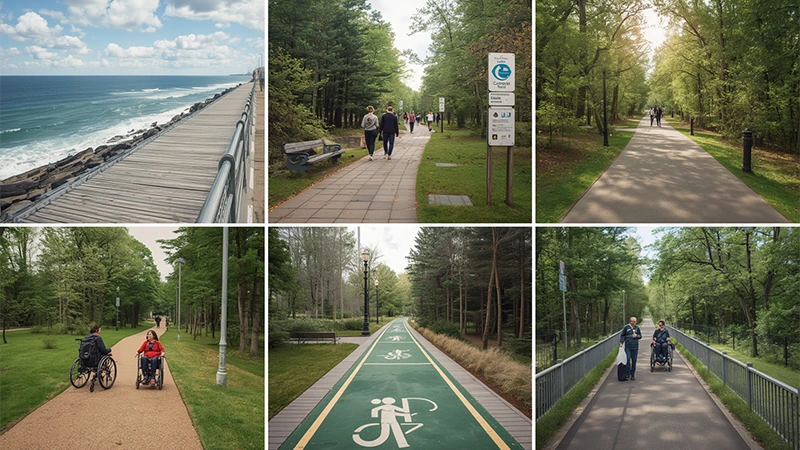
The best accessible trails are not just “easy.” They are predictable. They tell you what the surface is like, how steep the route gets, whether there are washrooms or benches nearby and how far you can go before turning back. That kind of detail matters whether you use a wheelchair, walk with a cane, push a stroller, travel with kids or simply want a gentler day outside.
Atlantic Canada: boardwalks, beaches and big views.
If your idea of a perfect hike includes ocean air and the sound of waves, Parks Canada’s accessible trail list is a great place to start. The Kellys Beach Boardwalk in Kouchibouguac National Park, New Brunswick, is listed as a 1 km return boardwalk over barrier island dunes. In Prince Edward Island National Park, Gulf Shore Way East is described as a paved, relatively flat 24.4 km return multi-use route along the coast, while Gulf Shore Way West offers 17 km of paved coastline near Cavendish and North Rustico. Source: Parks Canada accessible trails — https://parks.canada.ca/voyage-travel/experiences/accessibilite-accessibility/sentiers-trails
Cape Breton Highlands National Park also brings the drama without demanding a summit attempt. Parks Canada lists the Bog Boardwalk as a 0.5 km loop on boardwalk at the top of French Mountain, and Freshwater Lake Trail as a 1.7 km return boardwalk route near the ocean. Translation: short distance, big payoff, very Canadian scenery.
Ontario and the National Capital Region: access starts with information.
Ontario has a huge trail culture, but the most useful accessibility resources go beyond postcard photos. The Ontario Trails Council maintains an accessible trails directory that identifies routes with complete or partial wheelchair access, from urban waterfront paths to conservation-area walks. Source: Ontario Trails Council accessible trails — https://www.ontariotrails.on.ca/content/accessible-trails
Closer to Ottawa, the National Capital Commission’s Inclusive Trails initiative is especially useful because it focuses on choice. Its map highlights six trails in the Greenbelt and Gatineau Park, covering 11.8 km, and includes practical details such as trail length and width, surface type, slopes, obstacles, 360-degree trail photos, parking, toilets, benches and boardwalks. Source: National Capital Commission Inclusive Trails — https://ncc-ccn.gc.ca/places/inclusive-trails-ottawa-gatineau
From coast to coast: the Trans Canada Trail is mapping what matters.
The Trans Canada Trail is the big national story here. Its accessibility and inclusion work includes accessibility mapping, support for local improvements, inclusive trail-sector resources, adaptive trail activities and funding through its Trails for All stream. Source: Trans Canada Trail Accessibility and Inclusion — https://tctrail.ca/accessibility-and-inclusion/
That matters because “accessible” can mean different things to different people. A paved trail can still have a difficult slope. A boardwalk can still have narrow points. A short loop can still lack nearby washrooms. The move toward detailed mapping puts the decision back where it belongs: with the person planning the outing.
Why accessible trails are totally Fit & Fab.
Accessible hiking is not about lowering the adventure level. It is about widening the welcome. A great accessible trail can be a cardio cruise, a social outing, a mindful reset or a confidence-building first step back into nature. It can be a solo roll beside the water, a family walk through spruce bog, a multigenerational picnic route or a low-pressure way to enjoy fresh air after a long week.
The fun part? Canada is full of variety. You can choose red-sandstone coastline in P.E.I., Atlantic boardwalks in New Brunswick and Nova Scotia, urban nature in Ottawa–Gatineau, wetland lookouts in Ontario or mapped sections of the Trans Canada Trail across the country. The vibe can be rugged, relaxed, scenic, social or snack-forward. Yes, snack-forward is a valid hiking style.
Before you go: the Canadian trail-smart checklist.
Canadian sources and links.
- Share

Magazica Editorial Team
Magazica is a dedicated platform for businesses, subject matter experts, health advocates, and various sectors within the health industry. At Magazica, we are committed to sharing the latest health information and developments with our audience. We serve as a gateway for health-related businesses to showcase their progress and advancements, demonstrating how they contribute to enhancing people's wellness.

Healthy Aging: Why Strength Training Is a Cornerstone of Bone Density
As Canadians live longer, the conversation around healthy aging is shifting away from simply adding years to life...

The Importance of Rest Days in Your Summer Fitness Routine
As summer arrives with its long daylight hours and inviting outdoor conditions, the temptation to ramp up your fitness...

Outdoor Yoga: Canada’s Most Beautiful Studio Is Outside
Fresh air, birdsong, a mat beneath your feet, and the scent of pine or saltwater in the breeze—outdoor yoga is...

Shine in Sun: Train Safely for Summer Runs
You've finally tossed out the treadmill, spring is upon us, and that Canadian sun is starting to do some real work...

Puddle-Jumping Workouts: Embracing the Rain for Outdoor Cardio
Remember when you couldn’t resist jumping into a puddle right after it rained? Let's be honest...

Winter Hair Care: Nourish Your Locks When the Mercury Drops
Winter’s dry air and indoor heating can make hair brittle, frizzy and prone to breakage. Dermatologists...