The Toll Booth and the Meter: What Canning and Freezing Actually Cost Your Vegetables
What canning and freezing really do to nutrients, why heat sometimes helps, and the acidity rule that keeps home-preserved food safe.
Visualize a Saturday night in late August, and your kitchen windows have gone opaque. Outside it is still twenty-six degrees and sticky in the way only southern Ontario manages. Inside it is worse.
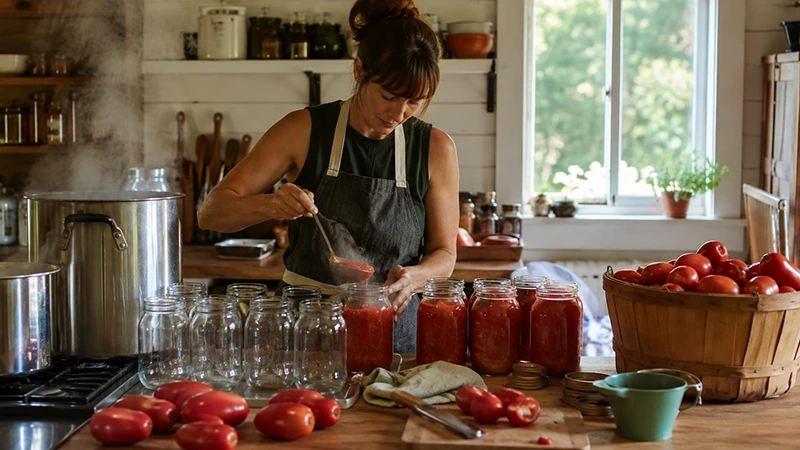
On the counter sits a bushel of Roma tomatoes bought at a roadside stand for a fraction of what the same tomatoes will cost you in February. Beside it, a tower of jars, a canner muttering on the back element, and one nagging thought.
Are you about to boil the good out of them?
The Toll Booth and the Meter.
Here is the mental model worth having. Every method of keeping food charges you in one of two currencies: a toll at the gate, or a meter that runs while you park.
Canning charges a hefty toll. The heat that makes a jar shelf-stable also destroys some of the water-soluble and oxygen-sensitive nutrients – vitamin C, the B vitamins. But once that toll is paid and the lid seals, the meter barely ticks. There is no oxygen in a sealed jar, so those same nutrients sit remarkably stable for months.
Freezing charges the opposite way. Blanching is a brief toll, so the initial loss is smaller – but the meter keeps running in the freezer, where slow oxidation nibbles away over the season. A two-part review of the research on this concluded something most people find backwards: nutrient loss in fresh produce during ordinary storage and cooking is often larger than we assume. The crisper has a meter too, and it runs fast.
Takeaway: Preserving does not add losses to fresh produce – it swaps a fast meter for a one-time toll.
What the Heat Gives Back.
Heat is not purely a tax collector, which is the part nobody mentions. In a 2002 study, tomatoes heated at 88 °C had more measurable trans-lycopene afterwards than raw ones – roughly two and a half times as much after fifteen minutes – because cooking breaks down cell walls and frees the compound up. Total antioxidant activity rose too.
That is a laboratory measurement of what’s extractable, not a demonstration that anyone got healthier, and the study is old enough now to be foundational rather than current. But it punctures a tidy myth. Your simmering pot of sauce is not only subtracting.
The steadier nutrients hardly notice any of this. Carotenoids, vitamin E, minerals and fibre come out broadly similar across fresh, frozen and canned versions of the same vegetable. In two California studies comparing eight commodities side by side, most showed no significant difference between refrigerated and frozen storage for minerals, fibre and phenolics – and for several vitamins, the frozen samples matched or beat the fresh ones. All of this work is American; no equivalent Canadian dataset exists, though there is no obvious reason a Canadian carrot would behave differently.
Takeaway: Some nutrients are dented by heat, some are freed by it, and most are indifferent.
The Risk You’re Not Worried About.
So the nutrition question, honestly, is close to settled and mildly reassuring. The question worth your attention is a different one, and it turns entirely on acidity.
Clostridium botulinum is an ordinary soil bacterium whose spores shrug off boiling water. Give it a low-acid, moist, sealed, oxygen-free environment – which is a precise description of a jar of home-canned beans – and it can produce one of the most potent toxins known. It changes nothing about how the food looks, smells, or tastes.
This is why the pH line at 4.6 matters more than any recipe. High-acid foods – most jams, pickled products, fruit – are held safe by their own acidity and a boiling water canner. Low-acid foods – beans, carrots, corn, peppers, meat, plain vegetable stock – need a pressure canner reaching about 116 °C, because boiling water alone cannot get there. Tomatoes sit awkwardly on the line: their acidity varies by variety and season, so provincial guidance is to add an acid such as lemon juice to tomato products rather than assume.
Perspective, because dread is not the goal. Across sixteen years of Canadian surveillance, 67 confirmed cases of foodborne botulism were recorded nationally – an average annual incidence of about 0.01 cases per 100,000 people – and only two of those outbreaks were traced to home-prepared foods. It is genuinely rare. It is also, when it happens, severe: seven in ten of those patients needed mechanical ventilation.
Takeaway: The jar cannot tell you it is unsafe, so the recipe has to.
A Kitchen That Keeps More.
Practically, most of what protects nutrients also protects safety. Preserve close to harvest rather than after a week of “crisper drift.” Use a tested recipe from a provincial health authority or a current preserving guide, and don’t improvise the acid, the pressure, or the timing. Cool jars undisturbed and label them with the date.
For the freezer, wrap tightly and keep the door closed – the meter runs on oxygen and temperature swings. And use what you froze this winter rather than the winter after; the losses are gradual, but they are real.
When in doubt, throw it out. Health Canada’s guidance is blunt on this point precisely because spoiled-looking food is not the danger; normal-looking food is. Never taste-test a suspect jar, and discard anything from a container that is bulging, leaking, or unsealed.
If someone develops nausea, dizziness, headache, double or blurred vision, a dry throat, or trouble swallowing or speaking after eating home-preserved food – typically twelve to thirty-six hours later – seek care promptly and say what was eaten. Contact your family doctor or local public health unit; 811 works in most provinces and territories for advice. If breathing or swallowing is affected, that is an emergency: call 911. Risk of serious illness runs higher in people who are pregnant, children under five, adults over sixty, and anyone immunocompromised.
Conclusion: Pay the toll knowingly, watch the acid, and February will thank you.
Key Takeaways.
This article is for informational and educational purposes only and does not constitute medical advice. It should not be taken as a medical diagnosis or treatment. Always consult with a qualified healthcare professional for personalized medical guidance.
Sources.
Bouzari, A., Holstege, D., & Barrett, D. M. (2015). Mineral, fiber, and total phenolic retention in eight fruits and vegetables: A comparison of refrigerated and frozen storage. Journal of Agricultural and Food Chemistry, 63(3), 951–956. https://doi.org/10.1021/jf504890k
Bouzari, A., Holstege, D., & Barrett, D. M. (2015). Vitamin retention in eight fruits and vegetables: A comparison of refrigerated and frozen storage. Journal of Agricultural and Food Chemistry, 63(3), 957–962. https://doi.org/10.1021/jf5058793
Dewanto, V., Wu, X., Adom, K. K., & Liu, R. H. (2002). Thermal processing enhances the nutritional value of tomatoes by increasing total antioxidant activity. Journal of Agricultural and Food Chemistry, 50(10), 3010–3014. https://doi.org/10.1021/jf0115589
Harris, R. A., Tchao, C., Prystajecky, N., Weedmark, K., Lefebvre, M., Tcholakov, Y., & Austin, J. W. (2023). Foodborne botulism, Canada, 2006–2021. Emerging Infectious Diseases, 29(9). https://doi.org/10.3201/eid2909.230409
Rickman, J. C., Barrett, D. M., & Bruhn, C. M. (2007). Nutritional comparison of fresh, frozen and canned fruits and vegetables. Part 1. Vitamins C and B and phenolic compounds. Journal of the Science of Food and Agriculture, 87(6), 930–944. https://doi.org/10.1002/jsfa.2825
Rickman, J. C., Bruhn, C. M., & Barrett, D. M. (2007). Nutritional comparison of fresh, frozen and canned fruits and vegetables II. Vitamin A and carotenoids, vitamin E, minerals and fiber. Journal of the Science of Food and Agriculture, 87(7), 1185–1196. https://doi.org/10.1002/jsfa.2824
Government of Québec. (2025). Home canning: Preparation and prevention. https://www.quebec.ca/en/health/nutrition/food-safety-risk-prevention/food-safety/preparing-cooking-food-safely/home-canning
Health Canada. (n.d.). Home canning safety. https://www.canada.ca/en/health-canada/services/general-food-safety-tips/home-canning-safety.html
HealthLink BC. (2023). Home canning – How to avoid botulism (HealthLinkBC File No. 22). https://www.healthlinkbc.ca/healthlinkbc-files/home-canning-how-avoid-botulism
- Share

Magazica Editorial Team
Magazica is a dedicated platform for businesses, subject matter experts, health advocates, and various sectors within the health industry. At Magazica, we are committed to sharing the latest health information and developments with our audience. We serve as a gateway for health-related businesses to showcase their progress and advancements, demonstrating how they contribute to enhancing people's wellness.
The Peel Deal: What the Research Actually Says About Apple Season
You're at a farm stand somewhere north of the city in late September. The air smells like cold dirt and cider...
Farmers’ Market Feasts: Maximizing Local Summer Produce
There is a moment in the Canadian summer—brief, golden, and intensely flavourful—when the farmers' market becomes...
Hydration Hacks: Beyond Plain Water for Summer Sweat Sessions
Canada's summers pack a punch. From the humidity of southern Ontario to the dry heat rolling across the Prairies...
Plant-Based Proteins: Fueling Muscle Recovery Naturally
Whether you're a weekend cyclist, a hockey player recovering from hard practice, or a gym-goer trying to...
The Gut-Brain Connection: How Early Spring Produce Feeds Your Mood
Do you feel weird this time of year? Canadian asparagus, peas, and rhubarb can fix that. You know that feeling...
Mindful Eating 101: Slowing Down, Chewing Thoroughly and Telling True Hunger From Emotional Cravings
In a world of constant multitasking and rushed meals, many of us finish a plate before our brains have even...