
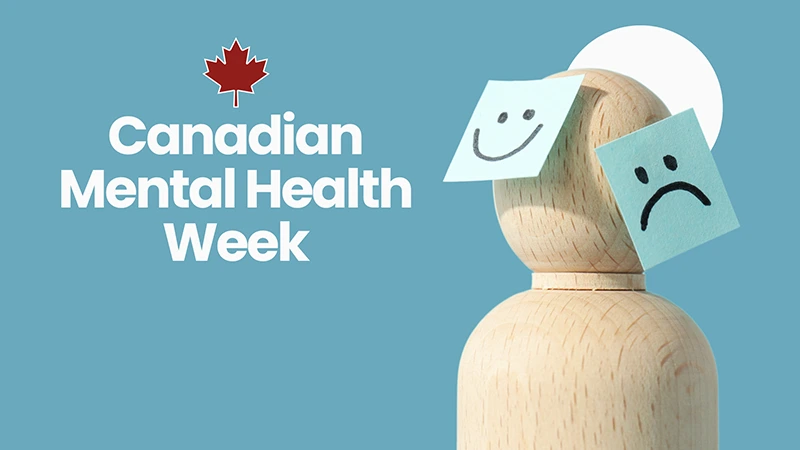
Come Together: Canadian Mental Health Week, May 4–10
Every May, something important happens across Canada. In schools, workplaces, community centres, and living rooms, millions of Canadians pause to talk about something that affects nearly every one of us — mental health. This year, Canadian Mental Health Week runs from May 4 to 10, and the theme set by the Canadian Mental Health Association (CMHA) is powerful in its simplicity: Come Together.
It is a call to action rooted in one of the most urgent public health realities of our time. Too many Canadians are struggling alone. Too many are wearing a mask — hiding anxiety, depression, grief, or burnout behind a composed exterior — because the stigma of mental illness still makes honesty feel dangerous. Mental Health Week exists to change that, one conversation at a time.
A Tradition Worth Knowing.
Canadian Mental Health Week is not new. First introduced by the CMHA in 1951, this year marks its 75th anniversary — making it one of the longest-running public health campaigns in Canadian history. What began as a modest awareness effort has grown into a national movement, with events in more than 330 communities across every province and territory (CMHA National, 2026).
The CMHA’s message this year is both timely and personal: social connection is essential to mental health, yet millions of Canadians report feeling lonely, often or always. The theme Come Together is a reminder that mental health is not just an individual challenge — it is a community responsibility. Small, everyday acts of connection — a phone call, a genuine conversation, checking in on a neighbour — can ripple outward in ways we rarely see but always feel.
The Numbers Tell a Difficult Story.
The warm spirit of Mental Health Week exists against a backdrop that is, frankly, troubling. The numbers are not abstractions — they represent real people in real communities across this country.
According to the Canadian Mental Health Association’s State of Mental Health in Canada 2024 report, the mental health of Canadians is now three times worse than it was before the COVID-19 pandemic. In 2019, roughly 9 percent of Canadians rated their mental health as “poor” or “fair.”
By 2021 that figure had climbed to 26 percent — and it has not meaningfully recovered (CMHA, 2024).
The Canadian Institute for Health Information (CIHI) reported in 2025 that 41 percent of adults with a diagnosed mental health condition said their care needs were only partially met or completely unmet. For young adults aged 18 to 34, that figure climbs to 52 percent. And only half of Canadians referred to community mental health counselling received care within 30 days (CIHI, 2025).
The financial barriers are stark. Fifty-seven percent of Canadians aged 18 to 24 who showed early signs of mental illness said cost was the primary obstacle to getting help. Mental health care in Canada is not enshrined as a medically necessary service under the Canada Health Act, meaning that outside of hospital care, most Canadians pay out of pocket or go without (CMHA, 2024).
Canada also lags well behind its peers in mental health spending. Provinces and territories average just 6.3 percent of their health budgets on mental health — compared to 15 percent in France, 11 percent in Germany, and 9 percent in the United Kingdom. CMHA is calling on the federal government to bring that figure to at least 12 percent.
Who Is Bearing the Heaviest Load.
The data makes it clear that mental health struggles are not distributed equally. Indigenous Peoples face the most severe barriers, with 38 percent reporting “poor” or “fair” mental health. Racialized and immigrant communities face systemic challenges, including language barriers, culturally inappropriate care, and discrimination. Canadians in rural and remote areas face acute shortages of qualified professionals.
Emergency departments — never designed to be the front door of mental health care — have absorbed a 47 percent increase in visits for mental health and substance use concerns. Hospitalization rates have risen 23 percent. For youth aged 14 to 17, the hospitalization rate increased by a staggering 136 percent over recent years (CMHA Toronto, 2024).
These are not statistics. They are human beings who ran out of other options.
What Mental Health Week Asks of Us.
In the face of numbers this sobering, it can be tempting to feel helpless. But Mental Health Week is a reminder that systemic change and personal action are not mutually exclusive — and that the personal often leads to the systemic.
CMHA is asking Canadians to do something beautifully uncomplicated: connect. Reach out to someone you haven’t spoken to in a while. Ask a colleague how they’re really doing — and mean it. Share your own experience if you feel safe to. Attend a local or virtual event. Wear green. Start a conversation in your workplace or classroom.
The science behind this ask is solid. Social connection is one of the most powerful protective factors for mental health. Loneliness, by contrast, carries health risks comparable to smoking 15 cigarettes a day. Connection is not a soft, feel-good add-on to mental health — it is medicine.
The Road Ahead.
Mental Health Week is one week. But the work it represents is year-round — in how we fund our health system, how we treat each other in our workplaces and communities, and how willing we are to be honest about our own struggles.
Canada has made progress. But as the CMHA’s own 2024 report concludes plainly: “Mental health has been profoundly neglected under universal health care since Medicare was introduced. Six federal governments in a row have failed to deliver free, universal mental health care — and Canadians are living with, and sometimes dying from, the consequences.”
This May 4–10, Come Together. Have the conversation. Make the call. The person on the other end may need it more than you know.
If you or someone you know needs support, contact the Canada Suicide Prevention Service: 1-833-456-4566 (24/7), or text HOME to 686868 to reach Crisis Services Canada.
References
- Canadian Mental Health Association — CMHA National (2026). Mental Health Week 2026: Come Together. https://cmha.ca/mental-health-week/
- Canadian Mental Health Association — CMHA (2024). The State of Mental Health in Canada 2024. https://cmha.ca/wp-content/uploads/2024/11/CMHA-State-of-Mental-Health-2024-report.pdf
- Canadian Institute for Health Information — CIHI (2025). Many Canadians with mental health disorders are not having their needs met. https://www.cihi.ca/en/taking-the-pulse-measuring-shared-priorities-for-canadian-health-care-2025/mental-health-and-substance-use-services-2025/many-canadians-with-mental-health
- CMHA Toronto (2024). The state of mental health in Canada: Ground-breaking CMHA report reveals troubling trends. https://cmhato.org/news/the-state-of-mental-health-in-canada-ground-breaking-cmha-report-reveals-troubling-trends/
- Canadian Institute for Health Information — CIHI (2024). Canadians report an increasing need for mental health care alongside barriers to access. https://www.cihi.ca/en/canadians-report-increasing-need-for-mental-health-care-alongside-barriers-to-access
- Share

Magazica Editorial Team
Magazica is a dedicated platform for businesses, subject matter experts, health advocates, and various sectors within the health industry. At Magazica, we are committed to sharing the latest health information and developments with our audience. We serve as a gateway for health-related businesses to showcase their progress and advancements, demonstrating how they contribute to enhancing people's wellness.

Splash Safely: Why Your Skin and Ears Might Throw a Summer Tantrum
Think about the ideal day out by the lake. The cooler is packed, you've found the perfect spot to lie on the beach, and now...

Men’s Health Checklist: Screenings You Shouldn’t Ignore This Year
For decades, Canadian men have embraced a "if it isn't broken, don't fix it" approach to health. “As a man, I can...

Eyes in the Digital Age: How the 20-20-20 Rule Can Ease Strain and Headaches
Staring at screens is a defining feature of modern life. Whether working from home or scrolling through social media...

Land as Medicine: How Reconnecting with Traditional Territories Heals Indigenous Youth
For countless generations, Indigenous Peoples have understood what Western science is only beginning to confirm...

The Canine Cleanup Crew: How Dogs’ Outdoor Adventures May Shape Our Microbiome and Immune System
When your dog charges back into the house after chasing squirrels or splashing through puddles, it picks up soil- and...

Move, Don’t Hibernate: Staying Active and Protecting Your Heart in Winter
When temperatures drop, exercise often falls by the wayside. Yet staying active in winter is crucial for...