The Overzealous Smoke Alarm: Why Back-to-School Anxiety Goes Off Before There Is a Fire
Back-to-school anxiety explained: what happens inside your child, what to watch for, what actually helps, and when to ask for more support.
It is the third week of August, and your kitchen has that thick southern Ontario stickiness that makes the fridge door sweat. The supply list has been stuck to it since June. You have already bought the wrong binder.
Your nine-year-old asks, again, whether Ms. Patel will be her teacher. She asked at breakfast. She asked in the car outside Canadian Tire. She asks now with a particular flatness you have learned to recognize, the kind that means the question was never really about Ms. Patel.
Somewhere in that small body, an alarm is going off. You just cannot hear it yet.
The Overzealous Smoke Alarm.
Every child comes with a threat-detection system, and like every smoke alarm, it is deliberately badly calibrated. It is built to shriek at burnt toast, because a false alarm costs you one bad morning and a missed fire costs you everything. Evolution took that trade, and it took it on your behalf.
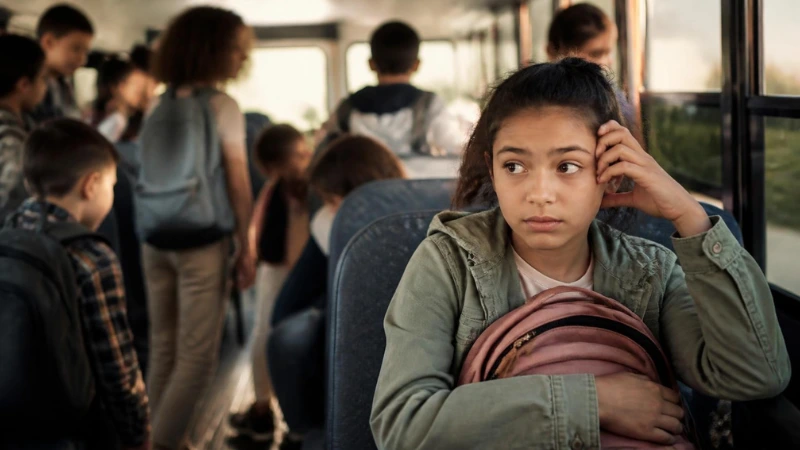
September is burnt toast. New room, new hallway, new bus route, new social order, new adult whose temperament is entirely unknown. The alarm cannot reliably tell a dangerous unknown from a merely unfamiliar one, so it treats them the same and sounds anyway.
What keeps it sounding is avoidance. Each time a child sidesteps the unfamiliar thing, the alarm gets what looks like proof it was right – the fire never came, so obviously the shrieking worked. Anxiety disorders are the most common mental health condition of childhood, affecting roughly one in fifteen children and adolescents worldwide, and this loop sits underneath most of them.
Takeaway: Anxiety is not a broken alarm; it is an alarm nobody ever tells the toast was fine.
The Usual Suspects, and the Quiet Ones.
Transitions are where the alarm gets loudest – the first year of school, the jump from a small building to a large one, the September a child arrives in a country whose classrooms run on unfamiliar rules. British researchers tracking children across the primary-to-secondary move found something worth clinging to: their worries generally shrank once they were actually there. Canadian evidence on this transition is thin, so hold it as a well-founded hope rather than a domestic finding.
The picture at home is less rosy. Statistics Canada followed the same young people from 2019 to 2023 and found the share rating their own mental health as fair or poor more than doubled, from 12% to 26% – self-ratings across four turbulent years, not diagnoses, and silent on why.
And the alarm is not only in the child. Parents going through their own version – new schedules, new costs, old memories of their own Grade 7 – are part of the room the child is reading.
Takeaway: The kids who go quiet in late August are often the ones doing the most work.
Bodies That Talk Before Kids Do.
Children under nine rarely announce that they feel anxious. They announce that their stomach hurts, at 7:40 a.m., on a Tuesday, with total sincerity – because it does.
In one clinical study of 128 children and adolescents with anxiety disorders, 96% reported at least one physical symptom and the average child reported six. Restlessness and stomach aches topped the list, ahead of racing heart and sweating. That was a small American treatment sample, not a Canadian survey – but it maps onto what the “Sunday-night stomach” looks like from a kitchen table.
Sleep is the other tell. In adolescents, sleep problems and anxiety travel together and appear to feed one another over time – which direction leads is genuinely unsettled, so a wrecked August sleep schedule is worth taking seriously in both directions at once.
Takeaway: Believe the stomach ache and stay curious about the week it belongs to.
The Rescue Reflex.
Here is the part nobody enjoys reading. When parents of anxious children are asked, nearly all of them report regularly changing their own behaviour to spare their child distress – answering for them, driving instead of the bus, letting the sleepover go. It is close to universal, and it is love doing exactly what love does.
It is also, on average, associated with more severe symptoms rather than fewer. A meta-analysis pooling studies of accommodation and childhood anxiety found a moderate positive association on parent-reported measures. Association is not causation, and the arrow plausibly runs both ways: more anxious children pull harder for rescue.
Takeaway: Accommodation is not a mistake you made; it is a dial you can turn.
What Actually Helps, and Where to Find It.
The strongest evidence sits with cognitive behavioural therapy. A Cochrane review of 87 trials and 5,964 young people found about 49% of children in CBT no longer met criteria for their main anxiety diagnosis afterwards, against about 18% on a waiting list. The same review is honest that CBT has not clearly outperformed usual care and rates the evidence as moderate to low.
More useful for a family on a waitlist: a randomized trial of 124 children found that working with parents alone – coaching them to reduce accommodation while staying warm – did as well as putting the child in CBT. The child never met a therapist. British trials of brief parent-delivered CBT point the same way, at lower cost.
Practically, that means rebuilding the sleep runway a week or two out, naming the feeling without arguing with it, choosing one small, brave thing rather than the whole hallway, and telling the school before the first bell rather than after the third absence.
If the worry is stopping a child from going to school, eating, sleeping, or seeing friends for weeks, that is the point to bring in help – not a crisis, just a conversation. Start with your family doctor or pediatrician, or call 811 where it operates in your province or territory. Ask your school board about its mental health lead; that route costs nothing and is often faster. Young people can reach Kids Help Phone any time at 1-800-668-6868 or by texting CONNECT to 686868, and anyone in Canada can call or text 9-8-8, the Suicide Crisis Helpline.
Conclusion: You are not trying to silence the alarm – you are helping a child learn, one small September morning at a time, that the toast is fine.
Key Takeaways.
This article is for informational and educational purposes only and does not constitute medical advice. It should not be taken as a medical diagnosis or treatment. Always consult with a qualified healthcare professional for personalized medical guidance.
Sources.
Ginsburg, G. S., Riddle, M. A., & Davies, M. (2006). Somatic symptoms in children and adolescents with anxiety disorders. Journal of the American Academy of Child & Adolescent Psychiatry, 45(10), 1179–1187. https://doi.org/10.1097/01.chi.0000231974.43966.6e
Iniesta-Sepúlveda, M., Rodríguez-Jiménez, T., Lebowitz, E. R., Goodman, W. K., & Storch, E. A. (2021). The relationship of family accommodation with pediatric anxiety severity: Meta-analytic findings and child, family and methodological moderators. Child Psychiatry & Human Development, 52(1), 1–14. https://doi.org/10.1007/s10578-020-00987-6
James, A. C., Reardon, T., Soler, A., James, G., & Creswell, C. (2020). Cognitive behavioural therapy for anxiety disorders in children and adolescents. Cochrane Database of Systematic Reviews, 11, CD013162. https://doi.org/10.1002/14651858.CD013162.pub2
Lebowitz, E. R., Marin, C., Martino, A., Shimshoni, Y., & Silverman, W. K. (2020). Parent-based treatment as efficacious as cognitive-behavioural therapy for childhood anxiety: A randomized noninferiority study of Supportive Parenting for Anxious Childhood Emotions. Journal of the American Academy of Child & Adolescent Psychiatry, 59(3), 362–372. https://doi.org/10.1016/j.jaac.2019.02.014
Lebowitz, E. R., Woolston, J., Bar-Haim, Y., Calvocoressi, L., Dauser, C., Warnick, E., Scahill, L., Chakir, A. R., Shechner, T., Hermes, H., Vitulano, L. A., King, R. A., & Leckman, J. F. (2013). Family accommodation in pediatric anxiety disorders. Depression and Anxiety, 30(1), 47–54. https://doi.org/10.1002/da.21998
Maynard, B. R., Heyne, D., Brendel, K. E., Bulanda, J. J., Thompson, A. M., & Pigott, T. D. (2018). Treatment for school refusal among children and adolescents: A systematic review and meta-analysis. Research on Social Work Practice, 28(1), 56–67. https://doi.org/10.1177/1049731515598619
Orchard, F., Gregory, A. M., Gradisar, M., & Reynolds, S. (2020). Self-reported sleep patterns and quality amongst adolescents: Cross-sectional and prospective associations with anxiety and depression. Journal of Child Psychology and Psychiatry, 61(10), 1126–1137. https://doi.org/10.1111/jcpp.13288
Polanczyk, G. V., Salum, G. A., Sugaya, L. S., Caye, A., & Rohde, L. A. (2015). Annual research review: A meta-analysis of the worldwide prevalence of mental disorders in children and adolescents. Journal of Child Psychology and Psychiatry, 56(3), 345–365. https://doi.org/10.1111/jcpp.12381
Rice, F., Ng-Knight, T., Riglin, L., Powell, V., Moore, G. F., McManus, I. C., Shelton, K. H., & Frederickson, N. (2021). Pupil mental health, concerns and expectations about secondary school as predictors of adjustment across the transition to secondary school: A longitudinal multi-informant study. School Mental Health, 13(2), 279–298. https://doi.org/10.1007/s12310-021-09415-z
Kids Help Phone. (n.d.). Our e-mental health services. https://kidshelpphone.ca/our-e-mental-health-services
Ontario Ministry of Health. (n.d.). Health811. https://health811.ontario.ca/
Statistics Canada. (2025, January 16). Rising mental health concerns among youth. https://www.statcan.gc.ca/o1/en/plus/7642-rising-mental-health-concerns-among-youth
- Share

Magazica Editorial Team
Magazica is a dedicated platform for businesses, subject matter experts, health advocates, and various sectors within the health industry. At Magazica, we are committed to sharing the latest health information and developments with our audience. We serve as a gateway for health-related businesses to showcase their progress and advancements, demonstrating how they contribute to enhancing people's wellness.

Your Fall Reset: Simple Routines That Help Habits Stick
There's a reason September feels like a second January for so many Canadians. As kids head back to school...
The Psychology of Play: Why Adults Need Summer Recess Too
As the long days of summer stretch out, many Canadian adults watch children fill parks and playgrounds while they...

Managing Vacation Anxiety – How to Unplug from the Office Truly
Visualize this. It is the first day of what has been anticipated by you all the way since March. You made an...

Sleep Hygiene Reboot: Adjusting to Longer Daylight Hours
Let us imagine that it is a Tuesday in late March. After a night's work and the yearly ritual known as the...
The Power of Morning Light: Resetting Your Circadian Rhythm for Spring
Imagine this: It is a Tuesday morning in early April, and you have at last changed your parka for a jacket. But as you...
The Developing Brain Under Fire: How War Trauma Rewires a Generation
New research from Gaza, Ukraine, and beyond reveals the profound neurobiological and psychological toll...