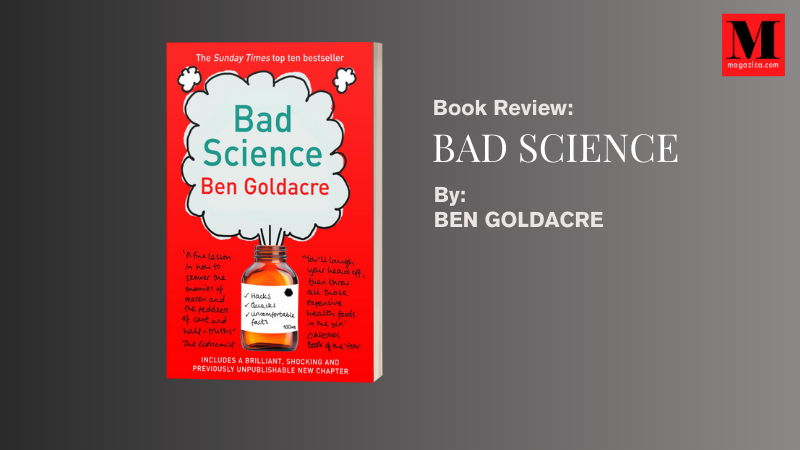
Book Review: ‘Bad Science’ by Ben Goldacre
A Tour Through the World of Quacks, Claims, and Questionable Cures
Why This Book Matters for Ordinary Readers
Wherever we look, health claims vie for our attention. “Take this supplement for instant energy!” “Use this cleanse to detoxify!” “A glass of red wine a day keeps your heart young!” These claims make good headlines and sensational ads. But how much do they tell us?
In Bad Science, British doctor and writer Ben Goldacre takes us on a lively ride through the world of health misinformation. He shows us how shaky research, clever marketing, and media excitement distort our understanding of science. This isn’t a book for medics in white coats. It’s for you and me — people who simply want to make sense of the flood of health advice coming our way every day.
Goldacre has a rare gift. He writes about complicated science without being boring. He is funny even when he reveals how easily we are fooled. And he gives us tools for spotting the deceptions so we can protect ourselves.
The “Oh No, Not That Too?!”” Moments
There are many remarkable examples in the book. Some are especially meaningful to Canadian readers:
Why We Keep Falling for It
Some of Goldacre’s charm lies in the fact that he never blames regular people for being misled. The real culprits are systems that incentivize hype over reality. Media organizations hunger for attention. Businesses hunger for sales. Self-proclaimed gurus hunger for power. In that competitive market, cautious science is hardly ever given a hearing.
Goldacre shows us science not as facts, but as a process — slow, cautious, and self-correcting. He reminds us that one study is never the whole story. Science builds up like a recipe: it needs many good ingredients, tried many times over, to make a reliable dish.
Analogies That Stick
Goldacre is at his best when using down-to-earth metaphors. Here are some that stuck with me:
These analogies make complex ideas easy to understand and remember, even for readers who haven’t studied science since high school.
Questions Worth Asking at the Dinner Table
Bad Science will leave you wanting to ask questions — not in some boring academic way, but in the way you would in a lively discussion over a meal or a cup of coffee:
1. Why are we so attracted to miracle cures, even when we think they are too good to be true?
2. Should learning to read health news be a part of basic literacy in Canadian schools?
3. What is the media’s responsibility in fact-checking health stories prior to publication?
4. Can placebos have a healthy role to play in modern medicine if we are honest about it?
5. How do we balance open-mindedness to new possibilities with skepticism toward untested assertions?
The Emotional Punch
For all the humour, there is a serious sting to this book. It hurts to recognize how regularly we have depended on awful evidence. Maybe we bought some mega-expensive supplement, shared a miracle headline on Facebook, or worried about an overblown risk.
But the book also sets us free. Once you see the smoke and mirrors, you are not so easily fooled. You learn to wait, to say, “Show me the evidence.” You’re empowered to challenge clever ads and suspect gurus.
Goldacre never does tell us all to become scientists. Instead, he gives us easy habits. Look for large, replicated trials. Distrust absolute claims. Look who might profit from a story. These habits form a kind of everyday armor against bad information.
Why Canadian Readers Should Care
In Canada, we are in a country where we trust health professionals and believe in universal healthcare. But we’re just as susceptible as anyone else to wellness trends, online misinformation, and media sensationalism. From detox teas peddled on Instagram to vitamin hype on pharmacy shelves, the need for keen thinking is constant.
Bad Science offers us just that — logical reasoning, with a pinch of humour. It serves as a reminder that science is the best friend of hope. Good science saves lives, if only we can safeguard it against manipulation.
The Verdict: A Must-Read Vaccine Against Health Hype ★ ★ ★ ★ ★
Ben Goldacre’s *Bad Science* is not just a book. It’s a survival guide for the health consumer of today. It arms us with skepticism, wit, and curiosity. It’s the kind of book that makes you double-check what you put in your body and what you share on social media.
Hot Take for the Group Chat:
Goldacre just made me side-eye half of the bottles in my kitchen cabinet. I’m pretty sure I have to take a few things back to Costco.”
P.S. If you have a family member who falls for every forwarded WhatsApp solution, gift wrap this book. Consider it a public service.
- Share

Suman Dhar
A qualified professional with extensive experience in education and human resources. As a HR Professional, Management Consultant, or Training Specialist, he is interested in cultivating intellect and curating insight.
The Simple Device That Is Keeping People Alive During an Age of Excessive Complexity: An Analysis of Atul Gawande’s “The Checklist Manifesto”
From Surgical Safety to Money Management: How Expertise Is Not Sufficient To Stop Avoidable Mistakes...
Why Your Microbiome is the Secret to Wellness: A Review of Giulia Enders’ “Gut”
To most of us, the gut is a "Quasimodo" in the body’s architecture – unappealing, uneven and disregarded until it...
Is Your Destiny Written in DNA? A Review of Siddhartha Mukherjee’s “The Gene”
Whereas the twentieth century could be described as the age of the splitting of atoms and the creation of the digital bits...
Can You Eat Your Way to a Longer Life? A Review of Michael Greger’s “How Not to Die”
Should one be browsing the selection in the health and wellness department of a Canadian bookstore, "How Not to Die"...
Your Body Explained Like Never Before: A Fascinating Tour from Head to Toe
If you were to take your body to a hardware store in an attempt to price out the various elements within...
The Nightly Elixir: Why Sleep is the Billion-Dollar Secret to Living Longer
What if there was a tool, a biological tool, that was part of all of our makeup, which could improve your memory...