

NeuroAgile: Where Brain Science Meets Multi-Agent Generative AI and Enterprise Scaled Agility
Part 1: The Case for NeuroAgile
“The success of Agile doesn’t lie in processes — it lives in the minds of those who practice it.”
The Plateau of Traditional Agility
Agile frameworks like Scrum, SAFe, and LeSS have transformed how we deliver value. They’ve decentralized decision-making, elevated customer centricity, and enabled incremental delivery at scale. But as Agile matures, many organizations are discovering a ceiling — a limit not in the frameworks themselves, but in human capacity to adapt, focus, and collaborate under persistent cognitive and emotional strain.
Enterprise delivery environments today are rich with complexity and volatility. Teams are expected to shift priorities rapidly, context switch frequently, and collaborate asynchronously across time zones, cultures, and cognitive profiles. Burnout is rising. Focus is fractured. Psychological safety is inconsistently cultivated. Agile ceremonies are sometimes reduced to rituals rather than catalysts for adaptation.
Agility, as it was envisioned, is hitting a neurological wall.
The Missing Layer: Cognitive Science
Despite the emphasis Agile places on individuals and interactions, few implementations consider how the brain actually works. Concepts like cognitive load, decision fatigue, neuroplasticity, attention residue, and emotion-regulation are rarely addressed in coaching models, PI planning cadences, or sprint reviews. Yet these are the very factors that govern team performance, adaptability, and creativity.
Just as DevOps brought engineering rigor into Agile delivery, it is now time to bring neuroscience into the heart of team dynamics and enterprise agility.
This is the foundation of NeuroAgile.
What is NeuroAgile?
NeuroAgile is a forward-looking, science-grounded evolution of Agile that integrates:
Together, these dimensions enable a new frontier in enterprise agility — one where we no longer treat people as interchangeable “resources” but as dynamic neurobiological systems with patterns, limits, and untapped potentials.
Why Now?
The convergence of four macro-trends makes NeuroAgile timely and necessary:
1. The Mental Health Crisis in Tech: Burnout, anxiety, and cognitive overload are increasingly cited as impediments to team stability and retention.
2. AI & Agentic Workflows: Teams now interact with not only each other but also with AI agents, virtual co-pilots, and automated systems.
3. Wearable Cognitive Tech: From Apple’s Cognitive Load tracking to EEG-powered focus monitors, we now have access to real-time bio-cognitive signals.
4. Remote & Hybrid Complexity: Distributed work challenges the neuro-social mechanisms (e.g., mirror neurons, synchronous learning, emotional contagion) that foster cohesion and alignment.
Agile must evolve. And that evolution must start at the level of neural architecture and cognition.
The Promise of NeuroAgile
NeuroAgile doesn’t replace Agile — it refines it. It injects a layer of evidence-based awareness into how teams are coached, how roles are supported, and how cadence is designed. Just as Agile helped us escape the rigidity of Waterfall, NeuroAgile helps us transcend the mechanical interpretation of Agile by:
In the sections ahead, we will explore the neuroscience foundations, system architecture, coaching models, and ethical implications of NeuroAgile. This is not a theory — it’s a transformational approach to human-centered agility.
Let’s begin with how the brain actually works in an Agile team context…
Part 2: The Neuroscience of Team Dynamics
“An Agile team is not just a group of professionals — it’s a cognitive network in motion.”
Understanding the Brain Behind the Team
At the heart of every Agile team is the human brain — complex, plastic, reactive, and wired for pattern recognition, social signaling, and emotional feedback loops. If we want to evolve our Agile practices, we must understand the neurocognitive architecture that underlies decision-making, collaboration, creativity, and resilience.
Let’s explore the key neuropsychological mechanisms that shape how Agile teams behave and perform.
1. Executive Function and Cognitive Load
Executive function refers to the brain’s ability to plan, focus attention, remember instructions, and juggle multiple tasks successfully. Located in the prefrontal cortex, these functions are central to managing sprints, adapting plans, and self-organizing work.
But these functions are finite. Teams operating under high levels of cognitive load — such as context switching, multiple concurrent ceremonies, and back-to-back virtual meetings — suffer from reduced strategic reasoning and short-term memory overload. This leads to:
In a NeuroAgile framework, we model cognitive budget as a key capacity metric, equal in importance to technical skill or team velocity.
2. The Neurobiology of Trust and Safety
Psychological safety — a critical enabler of team performance — is deeply rooted in the limbic system and the action of neurotransmitters like oxytocin and dopamine. These influence how we process feedback, respond to errors, and engage in group decision-making.
When a team feels threatened (e.g., micromanagement, fear of blame), the amygdala is activated, triggering a “fight or flight” response. In this state:
NeuroAgile practices aim to reduce perceived social threats in Agile spaces (retrospectives, demos, standups) through agentic co-moderation and stress-level sensing tools, fostering environments where prefrontal activity stays dominant.
3. Mirror Neurons and Empathic Synchrony
In a collocated Agile team, mirror neurons allow members to unconsciously model the emotions, intentions, and energy of others. This supports synchronous behaviors like pair programming, ideation, and adaptive feedback loops.
In distributed or hybrid teams, this empathic synchrony is weakened, leading to increased friction and misalignment. NeuroAgile systems compensate using:
These interventions strengthen inter-brain resonance, allowing teams to stay emotionally aligned — even when geographically scattered.
4. Flow State: The Gold Standard of Cognitive Engagement
The concept of flow, coined by psychologist Mihaly Csikszentmihalyi, describes a heightened state of focused immersion where performance and enjoyment peak. In this state:
Flow requires:
NeuroAgile teams aim to engineer flow-centric cadences — spacing deep work blocks, aligning sprint stories with skill calibration, and minimizing interruptions. AI agents help detect flow disruptors, such as Slack overload or task fragmentation, and nudge teams back to optimal mental environments.
5. Neuroplasticity and Agile Maturity
Neuroplasticity — the brain’s ability to rewire itself through learning and experience — is the biological engine of continuous improvement. It’s how Agile teams evolve from forming to performing.
Every retrospective, team experiment, or coaching interaction shapes team neural wiring. When feedback loops are consistent and emotionally safe, teams develop:
NeuroAgile embeds agent-driven reinforcement mechanisms to solidify positive behavioral patterns and make team evolution biologically self-sustaining.
Toward the NeuroCognitive Backlog
What if your backlog included not just features and tech debt — but also cognitive risk items?
In NeuroAgile, neuroscience informs not just retrospectives, but sprint planning, backlog prioritization, and team design — bringing brain-aware agility to the heart of delivery.
Part 3: Multi-Agent Gen AI Meets the Brain
“Artificial intelligence doesn’t need to replicate the human brain — it just needs to work with it.”
As Agile teams evolve into hybrid collectives of humans and machines, we enter a new frontier of delivery — one where generative AI doesn’t just accelerate tasks but becomes an active cognitive partner. In the context of NeuroAgile, these agents are not general-purpose chatbots. They are neurologically-informed collaborators that augment decision-making, focus, learning, and reflection.
This section explores how Multi-Agent Generative AI systems can be architected and deployed to support the brain-based behaviors of Agile teams in a SAFe context.
What Makes an AI “Neuro-Aware”?
To contribute meaningfully in a NeuroAgile team, an AI agent must be able to:
This is where MAGAI systems shine — because unlike single-task agents, multi-agent networks enable role-specific cognition augmentation at every layer of Agile delivery.
Role-Specific AI Agents in the NeuroAgile Ecosystem
Here’s how Multi-Agent AI can be deployed in concert with cognitive science to enhance Agile team performance:
1. Cognitive Load Balancer Agent
2. Focus Guardian Agent
3. Emotional Resonance Mapper
4. Neuroplasticity Coach Agent
5. Retrospective Intelligence Synthesizer
Architecture of a NeuroAgile™ Multi-Agent System
At a technical level, these agents can be coordinated using a framework like LangGraph, CrewAI, or AutoGen, which support:
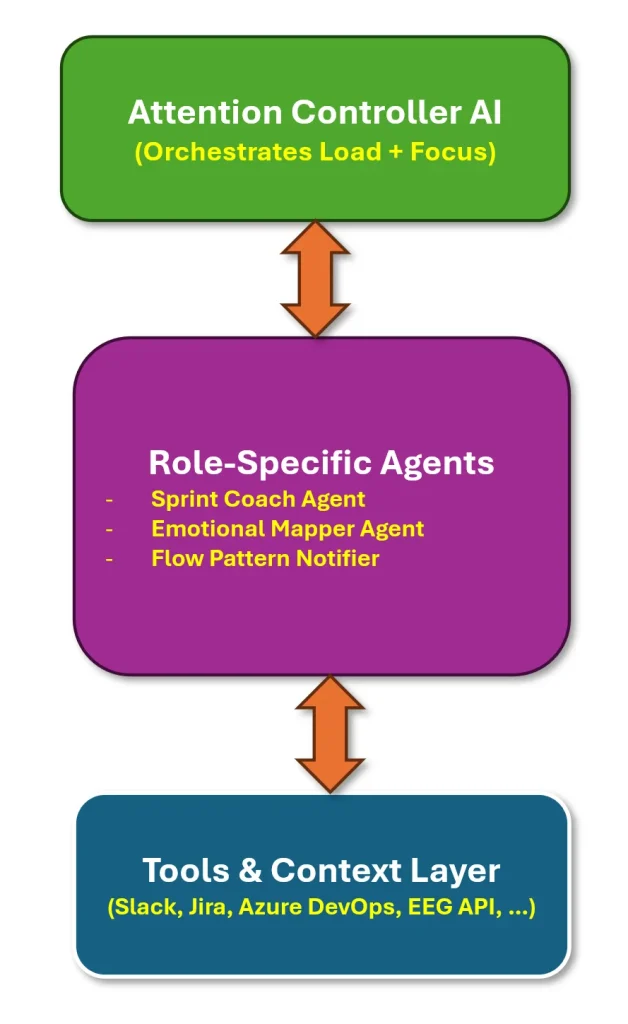
Each agent uses an LLM for natural language reasoning, a rules engine for neuro-behavioral pattern modeling, and memory shards for contextual awareness.
Sample Prompt for a Cognitive Load Agent
“””
You are a Cognitive Load Manager for an Agile team. Based on the following Jira sprint data and Slack logs, estimate the team’s cognitive burden this week. If the burden exceeds the cognitive comfort zone, recommend specific actions.
Comfort zone indicators:
– < 3 simultaneous in-progress tasks per team member
– No more than 2 hours/day in meetings
– Sentiment in Slack remains neutral or better
Data:
– Story assignments: [..]
– Meeting logs: [..]
– Slack thread sentiment: [..]
Provide a summary + recommended next steps.
“””
This agent can then return a response such as:
“Team appears to be operating above cognitive comfort thresholds. Consider deferring lower-priority items, reducing meeting frequency by 20%, and enforcing WIP limits. Also, encourage asynchronous updates for team members with repeated overlapping standup collisions.”
Coordinating AI With the Human Brain
To avoid over-automation, these agents must act more like thought partners than project managers. They nudge rather than direct, suggest rather than enforce.
They must also respect:
The success of NeuroAgile agents is measured not in throughput — but in sustainable focus, positive adaptation, and emotional resilience.
Part 4: Building the NeuroAgile Operating System
“If Agile is the rhythm of delivery, then the brain is the drummer — and it’s time we started listening to it.”
While many Agile implementations optimize ceremonies, artifacts, and roles, NeuroAgile goes deeper, aligning the team’s delivery system with the neurobiological architecture of focus, memory, emotion, and learning. To operationalize this, we must design a NeuroAgile Operating System (NAOS) — a cohesive blend of behavioral science, scalable practices, and intelligent augmentation.
This operating system becomes the backbone of a cognitively sustainable Agile ecosystem, scaling from Scrum teams to full SAFe ARTs and Solution Trains.
The Four Layers of the NeuroAgile OS
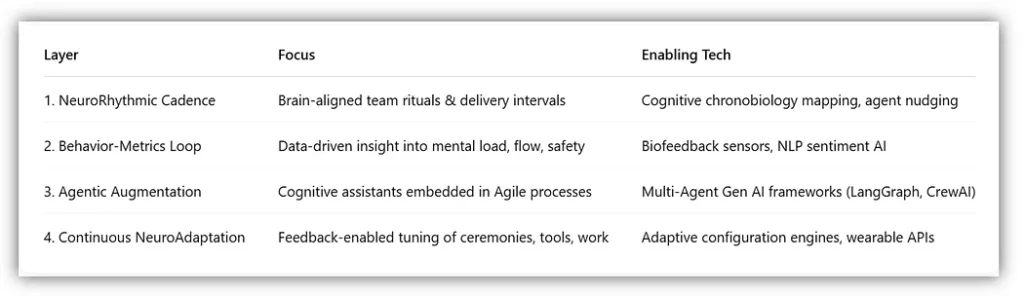
Each layer reinforces the others to create a living system — capable of learning, adjusting, and self-optimizing.
1. NeuroRhythmic Cadence Design
The human brain operates on ultradian and circadian rhythms — patterns of energy, attention, and alertness. In a NeuroAgile system:
Diagram: Sample NeuroRhythmic Weekly Sprint Template
Mon: Planning (10–12) | Deep Work (1–3) | Async Updates
Tue–Thu: Focus Blocks (AM) | Dev Syncs (PM) | Slack Shadows
Fri: Demo (10–11) | Retrospective (1–2) | Team Wind-Down
Agents such as the Focus Guardian enforce rhythm compliance by nudging schedule alignment and suggesting when to reschedule cognitive-disruptive events.
2. Behavior-Metrics Feedback Loop
The traditional Agile operating system measures velocity, predictability, and defect rates. NeuroAgile adds human-centered KPIs such as:
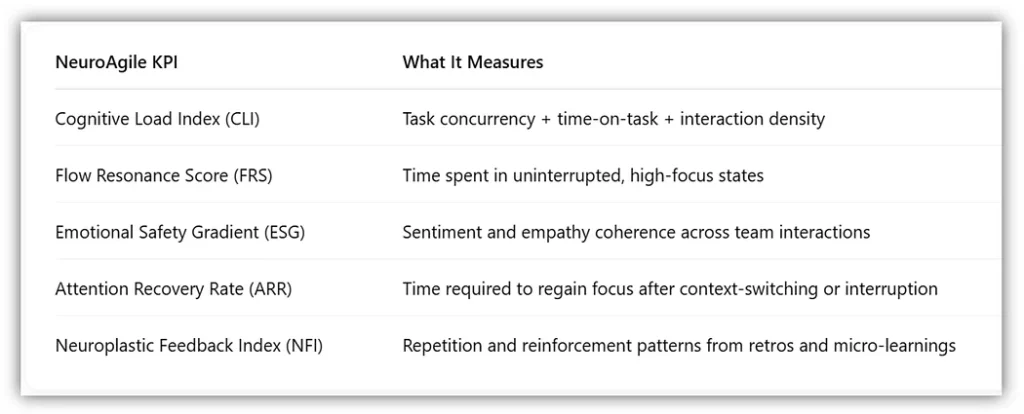
Data sources include:
These metrics are synthesized by AI agents and visualized in dashboards that coach both team behavior and ceremony design.
3. Agentic Augmentation Layer
This layer operationalizes the agents introduced in Part 3 by embedding them into ceremonial, tooling, and coaching contexts.
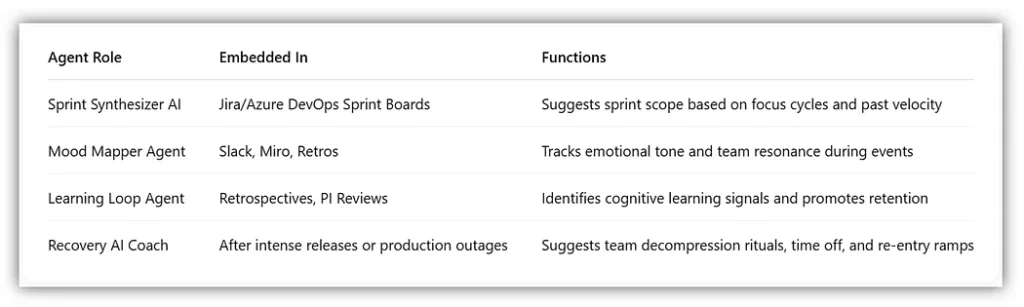
These agents are not simply observing — they are participating, supporting the team like a cognitive exoskeleton.
4. Continuous NeuroAdaptation
This layer handles the self-tuning behavior of the operating system. It ingests:
And responds by:
NeuroAgile coaches configure these adaptation policies. Over time, the system learns how to serve the team’s brain better than the team itself can.
Sample Use Case: Sprint Fatigue Recovery Loop
Scenario: After a major release, the ART shows lower mood, higher PR rejection rates, and increased time-to-merge.
NeuroAgile System Response:
1. Mood Mapper flags “post-release slump” sentiment.
2. Recovery Coach Agent recommends a rest sprint with lightweight goals.
3. Learning Loop Agent prompts the team with a guided retrospective focused on recovery and celebration.
4. Cognitive Load Balancer reconfigures sprint board to reduce concurrent work.
5. Slack notifications are downregulated; flow blocks are increased.
This is not “process for process’ sake” — this is biological empathy at enterprise scale.
Tools You Can Use Today
While the vision of a full NeuroAgile OS may seem futuristic, many components are available today:
The key is intentional integration — not adopting tools blindly but wiring them around cognitive goals.
Part 5: NeuroAgile in SAFe
“When we align strategy with structure, we scale. When we align cadence with cognition, we evolve.”
The Scaled Agile Framework (SAFe®) is built to manage complex enterprise delivery environments through synchronization, alignment, and decentralized decision-making. But even with its emphasis on Lean-Agile leadership, continuous learning culture, and flow, SAFe still assumes that human cognitive capacity is constant and infinite.
NeuroAgile corrects this by integrating neuroscience-aware practices and multi-agent augmentation into SAFe’s roles, events, and constructs. The result is a SAFe ecosystem that adapts to the mind — not just the market.
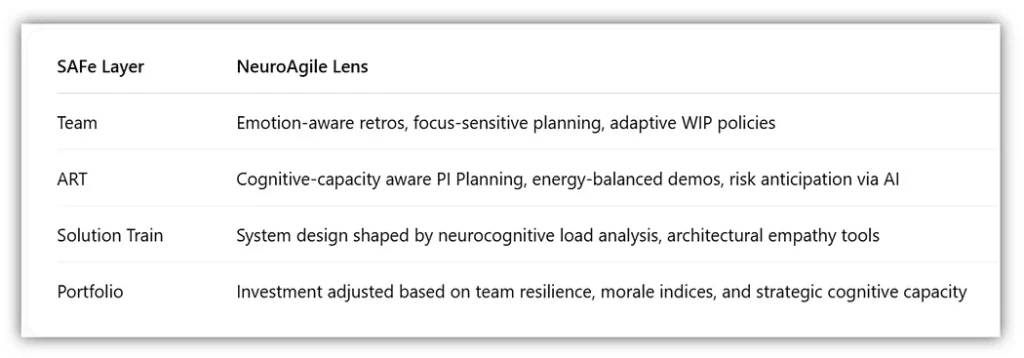
Enhancing Agile Teams Within SAFe
At the team level, NeuroAgile introduces AI and neuroscience into the flow of delivery:
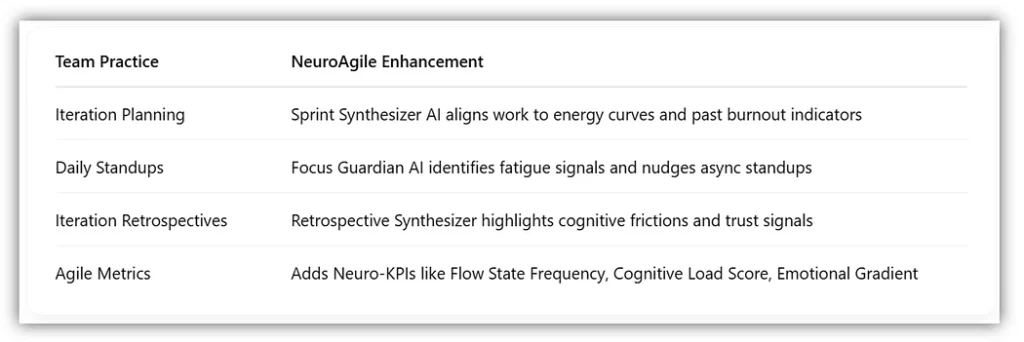
Team Coaches are equipped with Cognitive Dashboards, which combine bio-informed metrics (HRV, stress markers), tooling patterns (task switching, review loops), and sentiment analysis (tone in Slack/Teams). This enables neuroscience-enhanced backlog grooming, team health tracking, and resilience forecasting.
SAFe Agile Release Trains (ARTs) with NeuroAgile
In a NeuroAgile ART, synchronization events like PI Planning and System Demos become cognitively intelligent experiences.
PI Planning
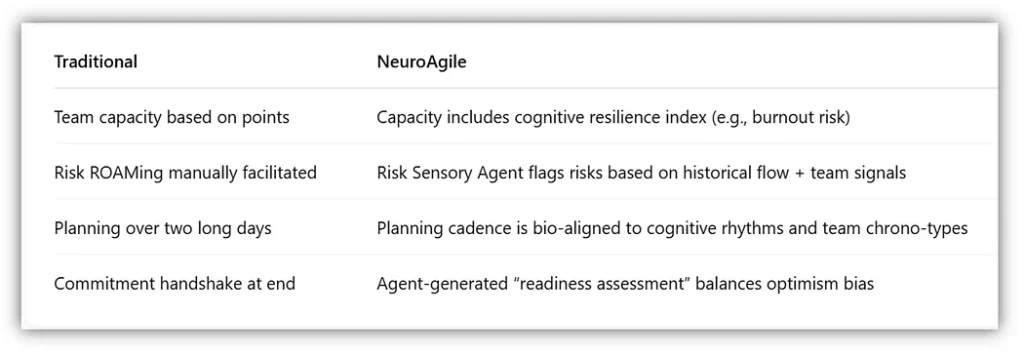
PI Planning becomes a simulation-rich, agent-augmented experience, where teams explore delivery scenarios not just based on capacity, but based on cognitive alignment and emotional readiness.
ART Syncs, Demos, and Inspect & Adapt
The RTE becomes a neuro-rhythmic orchestrator, coordinating not only backlog flow but neural sustainability across the ART.
Solution Trains and System Architecting
NeuroAgile augments Solution Trains with:
The Solution Train Engineer (STE) is supported by agents that recommend “cognitive scaffolding patterns” — ways to structure work that optimize understanding, reduce cross-team confusion, and preserve momentum.
NeuroAgile in Lean Portfolio Management (LPM)
At the Portfolio level, NeuroAgile integrates with Lean Portfolio Management by introducing neuro-strategic governance:
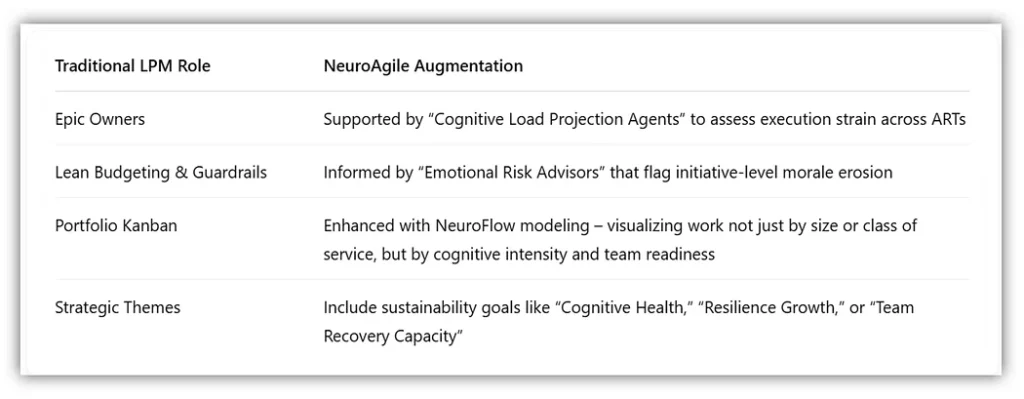
This approach repositions LPM from pure investment governance to strategic cognitive stewardship.
Cultural and Coaching Shifts
Integrating NeuroAgile into SAFe requires reframing roles:
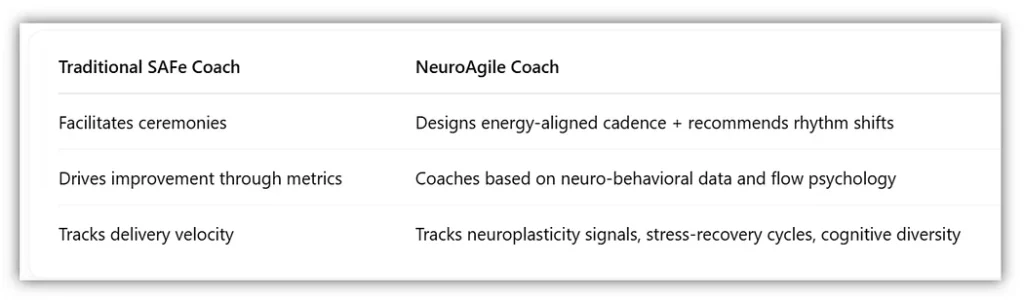
Lean-Agile Centers of Excellence (LACE) evolve into NeuroAgility Enablement Hubs, responsible for:
Example: Cognitive Flow Mapping for ART
Scenario: One ART sees regular delivery delays after lunch hours every Tuesday–Thursday.
Traditional Root Cause Analysis: Teams are misaligned on dependencies.
NeuroAgile™ Response:
1. Focus Agent detects drop in flow signals from 1–3pm.
2. Mood Mapper notes passive sentiment in chat logs during afternoon sessions.
3. Architecture Co-Pilot flags a complex integration task repeatedly attempted in that slot.
Suggested Action:
Outcome: A 17% increase in on-time feature delivery and 23% increase in reported flow state frequency.
NeuroAgile lens for SAFe Summary
Part 6: Real-World and Near-Term Application Scenarios
“We don’t need to wait for a neurological singularity to build smarter teams — just the courage to listen to what the brain already knows.”
NeuroAgile isn’t a theoretical moonshot — it’s a practical, incremental evolution of Agile delivery made possible by tools, insights, and organizational shifts that are already within reach. In this section, we’ll explore real-world use cases, pilot scenarios, and pragmatic paths to adoption that any transformation leader, Agile coach, or portfolio head can initiate today.
Scenario 1: Early Burnout Detection and Intervention
Context:
A cloud infrastructure team working across multiple time zones consistently hits delivery goals but begins showing signs of disengagement: low participation in retrospectives, minimal async comments, and rising PR rejection rates.
NeuroAgile Intervention:
Recommended Action:
Outcome:
Within 2 sprints, team engagement KPIs rebound, and average cycle time drops by 15% due to improved focus recovery.
Scenario 2: Onboarding for Cognitive Retention and Adaptation
Context:
A high-performing ART onboarded five new team members during PI Planning. Despite extensive documentation, onboarding is inconsistent, and new members are slow to contribute meaningfully.
NeuroAgile Intervention:
Outcome:
New members reach active contributor status 2 sprints sooner than historical average, with higher retention of workflow knowledge.
Scenario 3: Risk-Aware Portfolio Planning
Context:
A portfolio is planning multiple digital transformation initiatives. The LPM team needs a way to balance investment based on not only feature delivery potential but team resilience and neural sustainability.
NeuroAgile™ Intervention:
Outcome:
The portfolio shifts 20% of investment to high-readiness initiatives, improving time-to-value and reducing staff attrition by 12% YoY.
Scenario 4: Agent-Augmented Retrospectives
Context:
Team retros are flat, repetitive, and often miss latent issues. Trust is present, but insight velocity is low.
NeuroAgile Intervention:
Outcome:
Retrospectives become 30% shorter, more targeted, and result in better follow-through. Improvement items are delivered at 2x the prior rate.
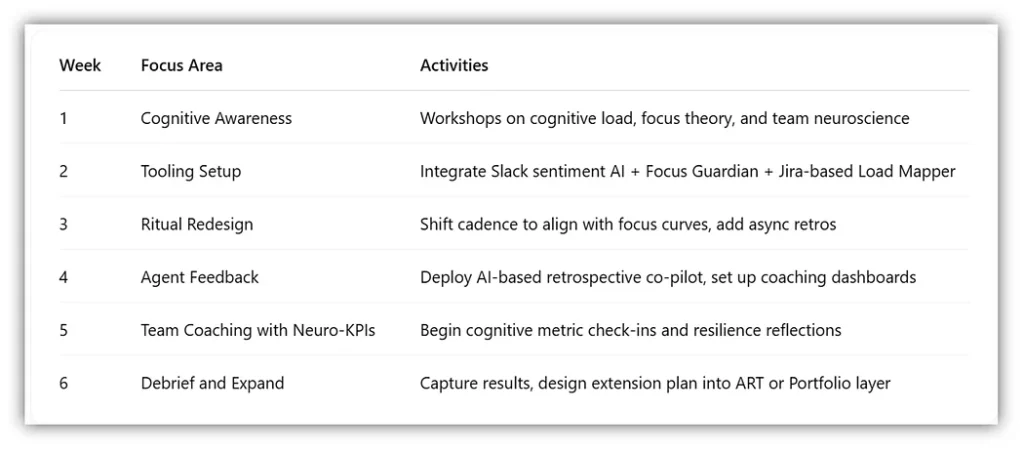
Pilot Blueprint: A 6-Week NeuroAgile™ Introduction Cycle
What a Fully NeuroAgile Delivery Org Looks Like
In a mature NeuroAgile organization, you’ll see:
This isn’t just scaling Agile. It’s scaling humanity through systems that understand the brain as part of the architecture — not just the operator of it.
Part 7: Ethical Considerations and Guardrails
“When technology reaches the mind, ethics must reach the core.”
As NeuroAgile integrates neuroscience, AI agents, behavioral monitoring, and biometric signals into enterprise Agile delivery, it unlocks extraordinary potential — but also introduces new ethical frontiers. Unlike traditional process optimization, NeuroAgile interacts directly with what makes us human: our cognition, emotions, and psychological states.
This section presents the ethical framework, risks, and practical safeguards necessary to implement NeuroAgile responsibly, inclusively, and transparently.
The Core Risks
1. Surveillance Creep
Tracking attention patterns, sentiment, and bio-signals may inadvertently cross into psychological surveillance, undermining trust and creating compliance anxiety.
2. Consent Ambiguity
In systems where AI agents observe team behavior or mine emotional tone, what constitutes meaningful and ongoing consent?
3. Neurodiversity Bias
AI models and cognitive metrics may normalize certain brain patterns (e.g., sustained focus) that disadvantage individuals with ADHD, anxiety, autism, or other neurodiverse profiles.
4. AI Feedback Misinterpretation
Poorly designed agent interactions may deliver suggestions that are:
Such outcomes damage psychological safety — the very foundation NeuroAgile aims to protect.
5. Invisible AI Influence
When AI agents subtly nudge priorities, task assignments, or ceremony flow, it becomes harder to distinguish collaborative augmentation from invisible steering.
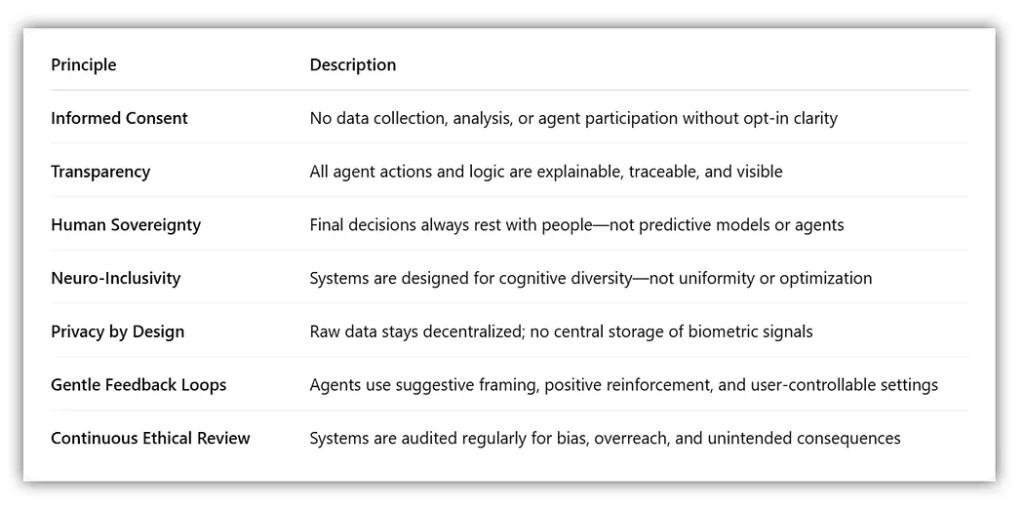
Guiding Ethical Principles
To address these risks, NeuroAgile must be rooted in seven design values:
Practical Guardrails and Protocols
1. Team-Level Ethics Charter
Before deploying NeuroAgile agents, teams co-create an “AI Charter” defining:
This ensures ethical alignment and psychological safety from day one.
2. Agent Transparency Layer
All agents must have a “Why I Suggested This” option, exposing:
If an agent nudges someone to reduce WIP or move a meeting, the person should be able to see the full context and choose to ignore or engage.
3. Opt-In Biometric Participation
Biofeedback collection (HRV, eye movement, focus levels, EEG) must be:
Agents that use biometric inputs should operate on self-modeling — suggesting improvements to the individual user first, without surfacing insights to the team or coach unless explicitly shared.
4. Inclusive Design for Neurodivergent Team Members
This ensures that cognitive augmentation doesn’t become cognitive homogenization.
5. Ethics as a Role in LACE
The Lean-Agile Center of Excellence (LACE) evolves to include an Ethics Steward, responsible for:
Ethics becomes not an afterthought — but a feature of the system’s DNA.
Human-in-the-Loop AI: A Non-Negotiable
All NeuroAgile agents must operate under a “human-in-the-loop” policy:
Instead, agents suggest, contextualize, and defer — ensuring people remain in control of how they think, act, and evolve.
A NeuroAgile Ethical Check-In Prompt
“Do our AI collaborators reflect our values?”
If the answer to any of these is unclear, then the system must pause, reflect, and revise.
Building Trust Through Transparency
The true power of NeuroAgile doesn’t come from its algorithms — it comes from the trust it builds between the system and the people it supports.
By embedding ethics at every level — from biofeedback prompts to LPM planning — we create an ecosystem where human intelligence and machine augmentation grow together, in service of sustainable, resilient, and inclusive agility.
Part 8: Becoming a NeuroAgile Organization
“You don’t adopt NeuroAgile. You become NeuroAgile — through culture, systems, and design.”
Integrating neuroscience and AI into Agile delivery isn’t just a tooling upgrade — it’s an organizational transformation. NeuroAgile challenges traditional assumptions about productivity, leadership, team health, and success. It shifts the enterprise mindset from “optimize for velocity” to “optimize for cognitive sustainability and learning capacity.”
In this section, we’ll explore what it takes to become a fully operational NeuroAgile organization: from roles and roadmaps to KPIs and culture building.
The NeuroAgile Transformation Roadmap
Becoming NeuroAgile requires a three-phase evolution:
Phase 1: Awareness & Measurement
Phase 2: AI-Augmented Rituals
Phase 3: Systemic Integration
NeuroAgile KPIs & Metrics
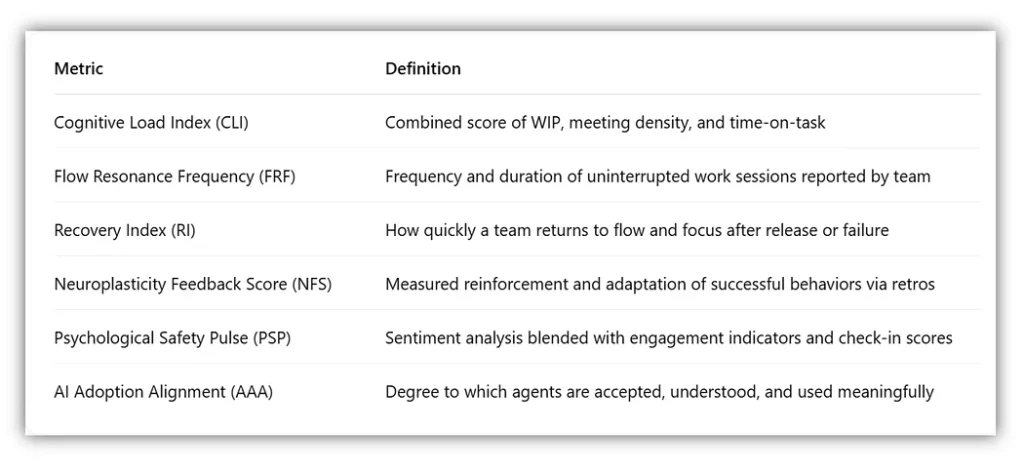
These KPIs are reviewed as part of ART Inspect & Adapt and LPM strategy syncs — not as compliance metrics, but as health signals for the brain of the delivery system.
The Role of the NeuroAgile Coach
The traditional Agile Coach becomes a NeuroAgile™ Coach — an enabler of brain-aware practices and ethical augmentation.
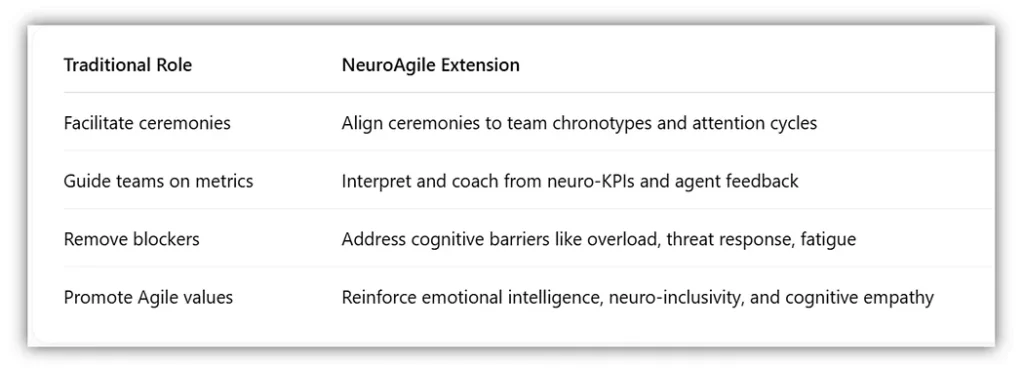
NeuroAgile Coaches also facilitate onboarding of new agents, audit feedback loops, and mentor team members on cognitive self-awareness.
Culture Shifts to Support NeuroAgility
To thrive, NeuroAgile needs a culture that normalizes cognitive dialogue.
From:
To:
This requires:
Building a NeuroAgile Operating Model
New Enabling Capabilities:
These build toward real-time human-machine collaboration aligned to brain function — not just business function.
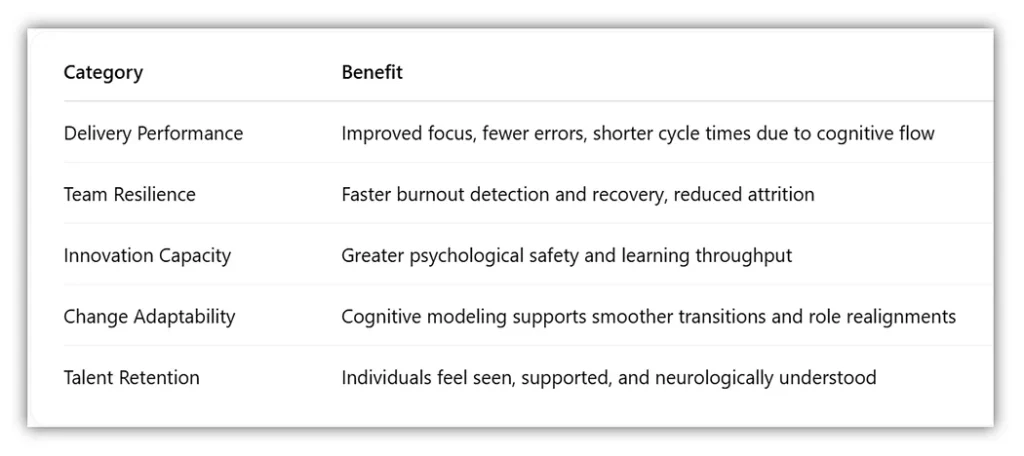
Long-Term Benefits of Becoming NeuroAgile™
Final Thought: The Conscious Organization
NeuroAgile leads toward something deeper: a conscious organization — one that learns not just through process improvement but through neural adaptation, emotional tuning, and collaborative intelligence.
By blending the precision of AI, the fluidity of neuroscience, and the structure of Agile, we design organizations that are no longer held together by meetings and tools — but by mental clarity, shared rhythm, and cognitive respect.
- Share

Dr. Arman Kamran
Arman Kamran is an enterprise transformation strategist and Multi-Agent Generative AI innovator with over two decades of experience leading automation-driven modernization across healthcare, government, financial services, and telecommunications. A member of the Harvard Business Review Advisory Council, Harvard Digital Data Design Institute (D³), and the Amazon Web Services Customer Experience Council, Arman operates at the intersection of intelligent automation, neuroscience-inspired design, and digital system transformation. He has led some of Canada’s most complex data-driven modernization programs, including the Ontario Panorama and Ontario Laboratory Information System (OLIS) initiatives—defining blueprints for interoperability, regulatory compliance, and scalable public-health platforms. Nationally, he also guided the Federal Data Hub and its AI-powered fraud-detection engine, and most recently architected an Integrated Healthcare GenAI Automation Solution that blends multi-agent intelligence, patient logistics, and cognitive augmentation across clinics and dispatch networks. A former early Certified Scrum Master, Arman has evolved beyond methodology to pioneer agentic augmentation frameworks—where autonomous AI agents act as cognitive collaborators across delivery ecosystems. His current research and implementation work focus on enabling self-organizing, neuro-adaptive enterprise systems that unite human decision-making with AI-driven precision. Arman is also a university educator, teaching transformative technology at the University of Texas, and a prolific author and speaker on Gen AI-enabled transformation, AI ethics, and the future of intelligent operations.

The Study Station Nobody Sells You
It's 1 a.m. You're in bed, laptop balanced on a duvet, chin tucked toward your chest like you're reading the fine print...

Blue Light Glasses: Fact or Fiction for Better Sleep?
As Canadians spend more time than ever staring at screens—with 72% clocking over 8 hours daily on digital devices...

Wearable Tech: Are Fitness Trackers Helping or Hurting Your Body Image?
“By the time you finish reading this sentence, your fitness tracker has likely logged another dozen steps.” In my own experience...

Ergonomics for the Hybrid Worker: Avoiding the Couch-Slouch
You're on a video call from your kitchen table, laptop propped on a stack of cookbooks, neck craned forward...

Digital Detox Weekends: Reclaiming Your Attention Span
So, if perusing your weekly screen time report is like binge-watching, well, you are certainly in good company...

Predictive Analytics in Public Health: Preventing Illness Before It Begins
A public health department identifies rising indicators of respiratory distress across a specific neighborhood...